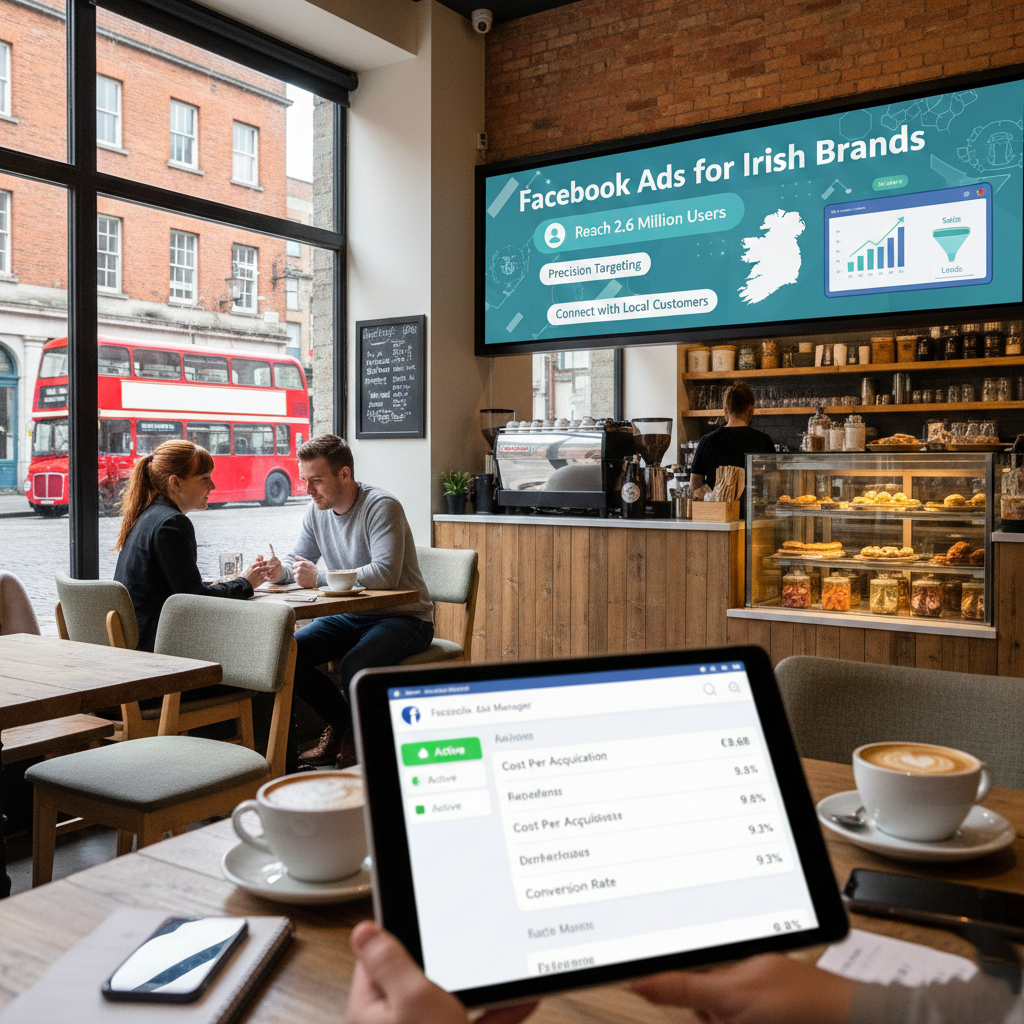
Facebook reaches 2.6 million users in Ireland, representing nearly half of the country’s population. For Irish businesses, this presents an unmatched opportunity to connect with local customers where they spend an average of 50 minutes daily. Whether you run a Dublin cafe, a Cork e-commerce store, or a Galway service business, Facebook advertising offers precision targeting and measurable results that traditional marketing simply cannot match.
This guide walks you through everything Irish brands need to know about Facebook Ads in 2025, from initial setup to advanced optimization strategies tailored specifically for the Irish market.
Understanding Facebook Ads in the Irish Market
The Irish digital advertising landscape presents unique opportunities for local businesses. With 58.1 percent of the eligible audience using Facebook, the platform dominates social media engagement across Ireland. More importantly, users aged 25 to 34 comprise 24.1 percent of Facebook’s Irish audience, followed closely by the 35 to 44 age group at 21.7 percent, representing the prime purchasing demographics for most businesses.
Ireland experiences higher CPM due to intense competition for user attention, reflecting the country’s engaged user base and strong purchasing power. However, this also means your ads reach audiences more likely to convert into paying customers.
Facebook Ads remain one of the most cost-effective advertising channels available to Irish businesses. The average CPC for Facebook ads was 69 cents in September 2025, making it more affordable than many alternative digital marketing channels. For Irish brands operating with euro budgets, understanding these costs helps in planning realistic campaign investments.
The platform’s strength lies in its sophisticated targeting capabilities. Irish businesses can reach specific audiences based on location, demographics, interests, and behaviors, ensuring every euro spent works toward reaching genuine potential customers.
Setting Up Your Facebook Business Manager Account
Before running your first ad, you need proper account infrastructure. Facebook Business Manager serves as your central hub for managing all advertising activities, keeping business operations separate from personal profiles.
Visit business.facebook.com and click “Create Account.” You’ll need to provide your business name, your name, and a business email address. The platform will send a verification email to confirm your identity. Once verified, you’ll enter your business details including address, phone number, and website URL.
Business Manager offers several crucial advantages for Irish advertisers. You can add team members without sharing login credentials, manage multiple ad accounts if you operate different brands, and maintain clear separation between personal and professional activities. Irish marketing agencies particularly benefit from this structure when managing client accounts.
After creating your Business Manager, add or create a Facebook Page for your business. This serves as your public presence and is required for running ads. Navigate to the Business Settings menu, select Pages, and either claim an existing page or create a new one. Add your business logo, cover photo, and essential information about your products or services.
Next, create an ad account within Business Manager. Go to Business Settings, select Ad Accounts, and click “Add.” Choose “Create a New Ad Account,” select Ireland as your location, and set your currency to Euro. This ensures all billing and reporting appears in your local currency, simplifying financial tracking.
Add a payment method to enable ad spending. Navigate to Payment Settings and add your credit card, debit card, or PayPal account. Irish businesses can use standard payment methods, and Meta processes charges in euros. Set spending limits if desired to maintain budget control.
For enhanced security, enable two-factor authentication. Navigate to Security Center in Business Settings and require authentication for all team members. This protects your ad account from unauthorized access and potential security breaches.
Installing the Facebook Pixel for Tracking
The Facebook Pixel is essential for tracking website activity and measuring ad performance. This small piece of code installed on your website allows Facebook to track conversions, optimize ad delivery, and build retargeting audiences.
Access your Pixel settings through Events Manager in Business Manager. Click “Connect Data Sources,” select “Web,” and choose “Facebook Pixel.” Name your Pixel, enter your website URL, and Facebook generates your unique Pixel code.
You have three installation options. For manual installation, copy the Pixel code and paste it into your website’s header section, just before the closing head tag. If you use WordPress, install a plugin like “PixelYourSite” or “Official Facebook Pixel” that simplifies the process. For platforms like Shopify or Wix, use their built-in Facebook integration tools that handle installation automatically.
After installation, test your Pixel using the Facebook Pixel Helper browser extension. Visit your website and the extension will confirm whether the Pixel fires correctly. You should see a green checkmark indicating successful installation.
Set up standard events to track specific actions like purchases, add to cart, lead submissions, or page views. These events feed data back to Facebook, enabling the platform to optimize your campaigns for valuable customer actions. Navigate to Events Manager, select your Pixel, and configure events either through the Event Setup Tool or by adding code manually.
Under GDPR regulations, businesses must ask for user consent to collect their personal information and explain how data will be used. Install a cookie consent banner on your website that allows Irish visitors to accept or decline tracking. Include clear information about how you use Facebook Pixel data in your privacy policy. This ensures compliance with Irish and EU data protection requirements.
GDPR Compliance for Irish Advertisers
Irish businesses must navigate GDPR regulations when processing personal data for behavioral advertising. The Irish Data Protection Commission actively enforces these rules, making compliance essential for all advertisers operating in Ireland.
Meta changed its legal basis for processing data for behavioral advertising from “Legitimate Interests” to “Consent” following regulatory guidance. For Irish advertisers, this means ensuring proper consent mechanisms are in place before collecting user data through custom audiences or Facebook Lead Ads.
When using Custom Audiences based on customer email lists or phone numbers, confirm you have obtained proper consent from individuals to use their data for advertising purposes. Document when and how consent was obtained. Include clear opt-out mechanisms in your communications.
For Facebook Lead Ads, ensure your lead forms clearly explain how you’ll use collected information. Include links to your privacy policy and make consent explicit rather than assumed. Users hold the right to delete their information whenever they want, so implement processes for handling deletion requests promptly.
Display cookie consent banners prominently on your website. Irish visitors must be able to accept or decline tracking before the Facebook Pixel collects their data. Pre-checked boxes or implied consent do not satisfy GDPR requirements. Provide granular controls allowing users to accept specific types of tracking.
Review your privacy policy to ensure it clearly explains your use of Facebook advertising tools, what data you collect, how you use it, who you share it with, and how users can exercise their rights. Make this policy easily accessible from your website footer and lead forms.
Creating Your First Facebook Ad Campaign
With your accounts configured and compliance measures in place, you’re ready to launch your first campaign. Facebook’s campaign structure consists of three levels: Campaign, Ad Set, and Ad. Understanding this hierarchy helps you organize and optimize your advertising efforts effectively.
At the Campaign level, select your advertising objective. Facebook offers objectives aligned with different business goals. Choose “Awareness” to reach people and build brand recognition. Select “Traffic” to drive visitors to your website or blog content. Pick “Engagement” to encourage likes, comments, and shares on your posts. Choose “Leads” to collect contact information through Facebook forms. Select “Sales” to drive purchases on your website or online store.
For most Irish businesses starting with Facebook Ads, the “Leads” or “Sales” objectives deliver the clearest return on investment. These objectives optimize ad delivery toward people most likely to take valuable actions.
At the Ad Set level, define your target audience. Start with location targeting specific to your Irish market. Select Ireland as your country, then narrow further to specific cities, regions, or even radius targeting around your physical location. Dublin retailers might target a 10-kilometer radius around their store, while service providers might target multiple cities across Ireland.
Add demographic targeting based on age, gender, and language. Review your customer data to identify your primary demographic segments. A children’s clothing store might target women aged 25-45, while a retirement planning service would focus on individuals 50-65.
Layer in detailed targeting using interests and behaviors. Facebook allows you to reach users based on their activities, pages they like, and topics they engage with. An Irish gym could target people interested in fitness, health & wellness, and healthy eating. A wedding venue might target people engaged within the past year.
Set your budget and schedule. Choose between daily budgets that spend a set amount per day or lifetime budgets spread across your campaign duration. The average cost per lead for Facebook ads was €8.68 in September 2025, helping Irish businesses estimate required budgets based on lead volume goals. Start with modest budgets of €10-20 daily while testing and learning what works for your business.
Select your ad placements. Facebook automatically recommends placements across Facebook, Instagram, Messenger, and Audience Network. For beginners, automatic placements typically deliver the best results as Facebook’s algorithm optimizes delivery. As you gain experience, test manual placement selection to focus budget on highest-performing platforms.
At the Ad level, create your actual advertisement. Choose your ad format based on your goals and creative assets. Single Image ads work well for product promotions and simple offers. Video ads capture attention and explain complex services effectively. Carousel ads showcase multiple products or tell stories across several cards. Collection ads are ideal for e-commerce businesses with multiple products.
Write compelling ad copy that speaks directly to Irish audiences. Reference local context, use familiar language, and address specific customer pain points. Your headline should grab attention in 5 words or less. The primary text should clearly communicate your value proposition and include a strong call to action.
Upload high-quality visuals that align with your brand and message. Images should be bright, clear, and relevant. Videos should hook viewers within the first 3 seconds. Ensure all creative assets meet Facebook’s technical specifications for resolution and aspect ratio.
Add a clear call-to-action button. Options include “Learn More,” “Shop Now,” “Sign Up,” “Contact Us,” or “Download.” Choose the CTA that best aligns with your campaign objective and desired customer action.
Before publishing, review all campaign settings carefully. Double-check your audience targeting, budget allocation, ad creative, and tracking pixels. Once satisfied, click “Publish” to launch your campaign.
Targeting Strategies for Irish Audiences
Effective audience targeting separates successful campaigns from wasted ad spend. With 3.065 billion users, precision matters more than ever. For Irish businesses, understanding local audience behaviors and preferences enhances targeting effectiveness.
Core Audiences for Local Businesses
Start with geographic targeting relevant to your service area. Irish businesses with physical locations should focus on city-specific targeting or radius targeting around their address. Service businesses can target entire counties or regions they serve. National brands can target all of Ireland while excluding areas where they don’t operate.
Combine location with demographic filters that match your customer profile. Review your existing customer data to identify age ranges, gender distributions, and other demographic patterns. Build audience segments that mirror your best customers.
Add interest-based targeting to reach people passionate about topics related to your products or services. An Irish craft brewery might target people interested in craft beer, Irish culture, food & dining, and local events. A Dublin accounting firm could target small business owners, entrepreneurs, and people interested in finance and investing.
Custom Audiences for Retargeting
Custom Audiences enable you to reach people who already know your business. These warm audiences typically convert at higher rates and lower costs than cold traffic. Upload customer email lists collected from purchases, newsletter signups, or inquiries. Facebook matches these emails to user accounts, allowing you to create audiences of existing customers or leads.
Create website visitor audiences using Facebook Pixel data. Target everyone who visited your site in the past 30, 60, or 90 days. Build more specific segments like people who viewed specific product pages, added items to cart, or visited your pricing page. These audiences indicate strong purchase intent.
Engage people who interacted with your Facebook or Instagram content. Target users who watched your videos, engaged with your posts, or visited your profile. These individuals have shown interest in your brand and are more receptive to advertising messages.
Lookalike Audiences for Scaling
Lookalike audiences remain a powerful way to expand reach with highly relevant users based on your best customer profiles. Select a source audience of your highest-value customers, ideally 1,000 to 5,000 people. Facebook analyzes this group and finds Irish users with similar characteristics, interests, and behaviors.
Start with a 1% Lookalike Audience for maximum precision. This targets the top 1% of Irish Facebook users most similar to your source audience. As campaigns mature, test larger percentages like 3-5% to expand reach while maintaining relevance.
Create multiple Lookalike Audiences from different source groups. Build one from purchasers, another from email subscribers, and a third from high-engagement website visitors. Test which performs best for your specific business goals.
Advantage+ Audiences for Automation
Meta Advantage+ audiences leverage machine learning technology to automatically optimize targeting. The platform analyzes campaign performance data and continuously adjusts targeting to reach users most likely to convert.
Advantage+ works best when you have strong creative assets and clear conversion tracking in place. Provide audience suggestions based on your understanding of ideal customers, but allow the algorithm flexibility to expand beyond these parameters when it identifies better-performing segments.
This approach particularly benefits Irish businesses with limited time for manual optimization. The AI handles targeting adjustments while you focus on creative development and business operations.
Choosing the Right Ad Formats
Facebook offers multiple ad formats, each suited to different marketing objectives and creative approaches. Selecting the right format enhances message delivery and engagement with Irish audiences.
Single Image Ads
The simplest format showcases one image with accompanying text. These ads work effectively for product promotions, event announcements, and straightforward offers. Use high-quality images that immediately communicate your value proposition. Include text overlays only when necessary, as Facebook may reduce delivery for images with excessive text.
Irish retail businesses use single image ads to showcase products, seasonal promotions, or in-store events. Service providers use them to highlight customer testimonials or key service benefits.
Video Ads
Video ads account for 37.5% of total ad spend on the platform and deliver strong engagement results. Videos capture attention in crowded newsfeeds and allow you to demonstrate products, explain services, or tell brand stories effectively.
Keep videos short and engaging, typically 15-30 seconds for optimal performance. Hook viewers within the first 3 seconds with compelling visuals or statements. Include captions since many users watch with sound off. End with a clear call to action directing viewers to take the next step.
Irish businesses use video ads to showcase behind-the-scenes content, customer testimonials, product demonstrations, and how-to guides that build trust and educate audiences.
Carousel Ads
Carousel ads display 2-10 scrollable images or videos within a single ad unit. Each card can feature a different product, benefit, or story element with its own link. This format works excellently for e-commerce businesses showcasing product catalogs, restaurants displaying menu items, or service providers highlighting multiple offerings.
Create cohesive storytelling across carousel cards. Lead with your strongest image or message, then guide users through your narrative. Each card should work independently while contributing to the overall message.
Collection Ads
Collection ads combine a cover image or video with multiple product images below, creating an immersive mobile shopping experience. When users tap the ad, it opens a full-screen Instant Experience that loads quickly and keeps users within the Facebook app.
Irish e-commerce businesses particularly benefit from collection ads. They showcase multiple products simultaneously while making it easy for customers to browse and purchase without leaving Facebook.
Lead Ads
Lead Ads allow users to submit information directly within Facebook without visiting your website. These forms auto-populate with user information, reducing friction and increasing conversion rates. They work perfectly for Irish businesses collecting newsletter signups, consultation requests, quote requests, or event registrations.
Keep forms short, requesting only essential information. Add privacy policy links and clear consent statements to maintain GDPR compliance. Set up instant email notifications so your sales team can follow up quickly with new leads.
Budgeting and Bidding for Irish Campaigns
Effective budget management ensures your advertising investment delivers maximum return. Understanding Facebook’s auction system and bidding options helps Irish businesses optimize spending.
Setting Appropriate Budgets
Start with modest daily budgets of €10-20 while learning what resonates with your audience. This conservative approach minimizes risk during the testing phase. As you identify winning ad combinations, gradually increase budgets to scale successful campaigns.
The average CPL for Facebook ads in September 2025 was €8.68. Use this benchmark to estimate how many leads your budget might generate. A €200 monthly budget at €8.68 per lead would generate approximately 23 leads.
Budget requirements vary significantly based on your industry, competition level, and campaign objectives. Irish businesses in competitive sectors like real estate or legal services typically require higher budgets than local service providers.
Choose between daily budgets that spend consistently each day or lifetime budgets spread across your campaign duration. Daily budgets suit ongoing campaigns while lifetime budgets work better for time-sensitive promotions or events.
Understanding Facebook’s Auction System
Facebook uses an auction to determine which ads to show. The platform considers three factors: your bid amount, estimated action rates (how likely users are to engage), and ad quality and relevance. The highest total value wins the auction, not necessarily the highest bid.
This system rewards advertisers who create engaging, relevant ads. High-quality creative can win auctions at lower costs than poor-quality ads with higher bids. Focus on ad relevance and engagement to improve cost efficiency.
Bidding Strategies
Lowest cost bidding allows Facebook to get the most results possible within your budget. The algorithm automatically adjusts bids to achieve the lowest cost per result. This strategy works well for most Irish advertisers, especially those new to Facebook advertising.
Cost cap bidding maintains your average cost per result at or below your specified amount. This approach provides more control over costs but may limit campaign volume if your cap is too restrictive. Use this strategy when you have specific profitability targets requiring strict cost control.
Bid cap bidding sets the maximum amount you’ll pay for individual ad auctions. This offers the most control but requires deeper understanding of campaign performance and audience behavior. Reserve this strategy for experienced advertisers with substantial historical data.
For most Irish businesses starting with Facebook Ads, stick with automatic bidding and lowest cost strategy. Let Facebook’s algorithm optimize bids while you focus on improving ad creative and targeting.
Monitoring and Adjusting Budgets
Review campaign performance daily during the first week, then shift to weekly reviews for ongoing campaigns. Monitor key metrics like cost per result, frequency, and return on ad spend. Increase budgets on high-performing ad sets showing efficient cost per result. Pause or reduce budget on underperforming ad sets that exceed your target costs.
Avoid making major budget changes of more than 20-30% at once. Large adjustments reset Facebook’s learning phase, temporarily reducing campaign efficiency. Make gradual changes that allow the algorithm to adapt.
Measuring and Optimizing Campaign Performance
Tracking the right metrics enables data-driven decisions that improve campaign results. Facebook provides extensive reporting tools through Ads Manager.
Key Metrics for Irish Businesses
Focus on metrics directly tied to your business objectives. For awareness campaigns, track reach, impressions, and cost per thousand impressions (CPM). For consideration campaigns, monitor link clicks, landing page views, and cost per click (CPC). For conversion campaigns, measure purchases, leads, cost per acquisition (CPA), and return on ad spend (ROAS).
The average conversion rate for Facebook ads is 9.3% on mobile, providing a benchmark for evaluating your campaign performance. Irish businesses achieving conversion rates at or above this level are performing well.
Frequency indicates how many times the average person sees your ad. Optimal frequency ranges from 1-3. Higher frequencies lead to ad fatigue, reducing performance and increasing costs. When frequency exceeds 4-5, refresh your creative to maintain audience interest.
Relevance score (now called quality ranking, engagement rate ranking, and conversion rate ranking) shows how your ad compares to competing ads targeting similar audiences. Higher rankings indicate better ad performance and typically result in lower costs.
Attribution and Conversion Tracking
Set up conversion events in Events Manager to track valuable customer actions. Configure standard events like purchases, leads, add to cart, and registrations. Create custom conversions for specific actions unique to your business.
Choose attribution windows that align with your customer journey. The 7-day click attribution credits conversions occurring within 7 days of ad clicks. This setting works well for most Irish businesses with moderate consideration periods. For longer sales cycles, consider 28-day attribution windows.
Review the conversion path report to understand how customers interact with multiple touchpoints before converting. Irish customers might see your ad on mobile, visit your website on desktop, and convert days later. Attribution helps credit these conversions properly.
A/B Testing for Continuous Improvement
Test one variable at a time to clearly identify what drives performance changes. Compare different audiences to find which demographic or interest segments respond best. Test various ad formats to determine whether video, carousel, or single image performs strongest. Try different creative approaches, testing emotional appeals versus rational benefits, or different visual styles.
Run tests for at least 3-7 days to gather sufficient data. Ensure each variation receives adequate budget and impressions to reach statistical significance. Facebook’s A/B testing tool automatically splits audiences and budgets evenly between test versions.
Implement winning variations while continuously testing new elements. Optimization is ongoing, not a one-time activity. Consumer preferences evolve, competition changes, and ad fatigue occurs. Regular testing keeps campaigns fresh and performance strong.
Optimization Tactics
When campaigns underperform, review each element systematically. Poor targeting wastes budget on people unlikely to convert. Refine your audience using narrower demographic filters or more specific interests. Weak creative fails to capture attention or communicate value clearly. Test new images, video content, or messaging approaches that better resonate with Irish audiences.
Bidding issues occur when your bids are too low to compete effectively or your budget constraints limit delivery. Review auction insights to understand your competitive positioning. Increase bids or budgets if you’re losing auctions consistently.
Landing page problems reduce conversion rates even when ads perform well. Ensure your landing page matches ad messaging, loads quickly on mobile devices, and includes clear calls to action. Poor landing page experiences waste ad budget by attracting clicks that don’t convert.
Advanced Strategies for Irish Businesses
Once you’ve mastered basic campaigns, advanced tactics can further improve results and efficiency.
Retargeting Campaigns
Retargeting reaches people who previously interacted with your business but haven’t converted. These warm audiences convert at significantly higher rates than cold traffic. Create website visitor audiences using Facebook Pixel data. Build segments for recent visitors (last 7 days), engaged visitors (30 days), and older visitors (60-90 days).
Serve different messages to each segment. Recent visitors might need a simple reminder or special offer. Engaged visitors who viewed specific products could receive testimonials or additional product information. Older visitors might respond to broader brand messaging or new product announcements.
Create engagement audiences from people who interacted with your Facebook or Instagram content. Target video viewers with follow-up messages driving them to take action. Reach people who engaged with posts but didn’t click through to your website.
Campaign Budget Optimization
Campaign Budget Optimization (CBO) automatically distributes budget across ad sets within a campaign. Rather than setting individual ad set budgets, you provide one campaign-level budget and Facebook allocates spending to the best-performing ad sets.
CBO improves efficiency by shifting budget toward audiences and placements that deliver the lowest costs. This reduces manual optimization time and often improves overall campaign performance. Enable CBO for campaigns with multiple ad sets targeting different audiences or testing different creative approaches.
Dynamic Creative
Dynamic Creative automatically tests different combinations of images, videos, headlines, and descriptions to identify the best-performing combinations for each person. Upload multiple creative assets and headlines, and Facebook’s system assembles and delivers various combinations.
This approach reduces manual creative testing effort while potentially identifying winning combinations you might not have tested manually. Dynamic Creative works particularly well for e-commerce businesses with multiple product images to test.
Seasonal Campaign Planning
Irish businesses should plan campaigns around key shopping periods and local events. Build awareness campaigns 4-6 weeks before major holidays. Launch conversion campaigns 2-3 weeks before key dates when purchase intent peaks. Adjust messaging and creative to reflect seasonal themes and occasions.
Research shows Irish consumers increase social media engagement during evening hours and weekends. Schedule ads for peak engagement times to maximize visibility and performance.
Common Mistakes to Avoid
Learning from common pitfalls helps Irish businesses achieve better results faster.
Targeting Too Broadly
Casting too wide a net wastes budget on people unlikely to convert. While reaching more people might seem beneficial, precision targeting delivers better results at lower costs. Start narrow and expand only when you’ve exhausted your core audience.
Neglecting Mobile Optimization
Mobile devices account for 94.1% of all Facebook ad impressions, making mobile optimization essential. Review how your ads and landing pages display on smartphones. Ensure text remains readable, images display properly, and forms work smoothly on mobile devices.
Ignoring Ad Fatigue
Running the same creative for extended periods reduces performance as audiences grow tired of seeing identical content. Monitor frequency metrics and refresh creative every 2-4 weeks. Test new images, videos, and messaging to maintain audience interest and engagement.
Not Testing Enough
Relying on assumptions rather than data limits performance. Test different audiences, creative approaches, and campaign structures. Small improvements across multiple elements compound into significantly better overall results.
Poor Landing Page Experience
Sending traffic to irrelevant, slow-loading, or confusing landing pages wastes ad spend. Ensure landing pages match ad messaging, load quickly, work well on mobile, and include clear calls to action. Poor landing page experiences destroy otherwise successful campaigns.
Inadequate Tracking Setup
Running campaigns without proper conversion tracking makes optimization impossible. Install Facebook Pixel correctly, set up conversion events, and verify tracking works before spending significant budget. Data-driven optimization requires accurate data.
Resources and Next Steps
Success with Facebook Ads requires ongoing learning and adaptation. Stay updated with Meta’s official Business Help Center for platform changes and new features. Join Facebook advertising communities to learn from other Irish marketers’ experiences and challenges.
Consider professional digital marketing services when campaigns require expertise beyond your internal capabilities. Experienced agencies understand the Irish market nuances and can accelerate results while avoiding costly mistakes.
Start with one focused campaign testing core hypotheses about your audience and messaging. Gather data, learn what works, and gradually expand your advertising efforts. Facebook advertising success builds over time through continuous testing, learning, and optimization.
For Irish brands ready to harness Facebook’s advertising power, the opportunity is substantial. With proper setup, strategic targeting, compelling creative, and ongoing optimization, Facebook Ads deliver measurable business growth at manageable costs. Begin with the fundamentals outlined in this guide, measure your results carefully, and refine your approach based on data and performance.
Your competitors are already advertising on Facebook. The question isn’t whether to use Facebook Ads, but how effectively you’ll use them to reach and convert Irish customers. Take the first step today by setting up your Business Manager account and planning your initial campaign. The insights and results you gain will inform increasingly successful campaigns that drive real business growth.