
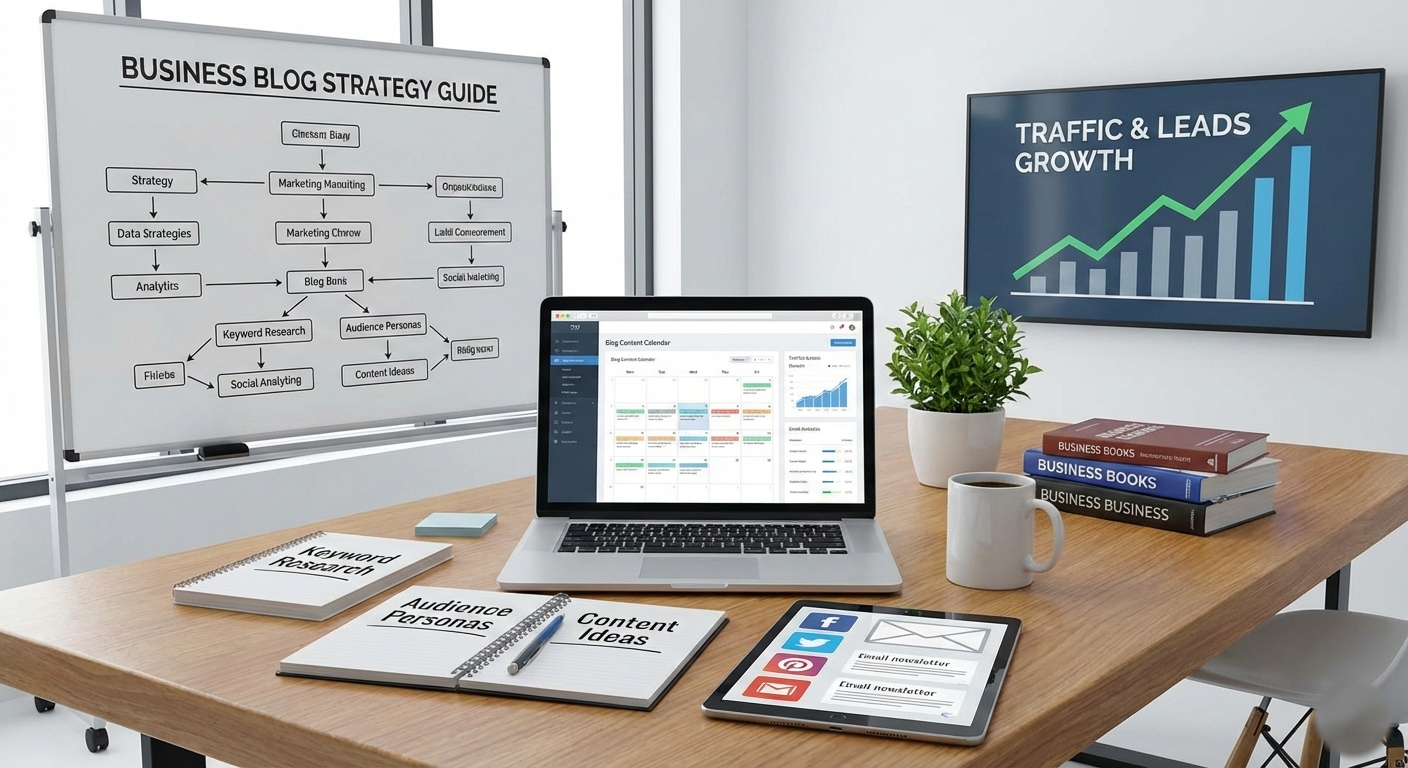
Running a business in 2026 without a blog? That’s like opening a shop but forgetting to put up a sign. You might have brilliant products or services, but if nobody knows about them, what’s the point?
Here’s something that might surprise you: businesses that blog consistently generate 67% more leads than those that don’t. Even more impressive? Companies with active blogs get 97% more links to their website. Those aren’t just numbers—that’s potential revenue walking past your digital doorstep.
But here’s the thing: most business owners know they should blog. The question is how to do it effectively without wasting time or money. That’s exactly what this business blog strategy guide will show you.
Whether you’re a startup in Dublin or an established enterprise in Cork, this comprehensive business blog strategy guide will transform your blog from an afterthought into a genuine business asset. No fluff, no theory—just actionable steps you can implement today.
Why Every Business Needs a Blog in 2026
Let’s address the elephant in the room: “Isn’t blogging dead? Everyone’s on TikTok and Instagram now!”
Short answer? No. Blogging is very much alive, but it’s evolved.
Modern blogging isn’t about writing diary entries and hoping someone reads them. It’s a strategic digital marketing tool that works while you sleep. This business blog strategy guide will show you exactly why and how. Here’s what a well-executed blog does for your business:
Attracts Organic Traffic: Every blog post is a new page that Google can index. More pages mean more opportunities to rank for keywords your potential customers are searching for. While social media posts disappear into the void after 24 hours, blog content compounds over time.
Establishes Authority: When someone searches “how to improve my website’s conversion rate” and finds your comprehensive guide, you’re not just another company—you’re an expert. This positions your brand as the obvious choice when they’re ready to invest in web development or other services.
Generates Qualified Leads: Blog readers who convert are often higher-quality leads. Why? They’ve already consumed your content, understand your expertise, and trust your knowledge. They’re pre-qualified and ready to engage.
Supports Every Other Marketing Channel: Your blog content fuels your social media, email newsletters, and even your Google Ads campaigns. It’s the foundation that makes everything else work better.
Provides Long-Term ROI: Unlike paid advertising that stops the moment you stop paying, blog content continues delivering value for months or years. A single well-optimized post can generate consistent traffic and leads indefinitely.
The data backs this up. According to HubSpot’s research, 56% of marketers who leverage blogging say it’s effective, and 10% report it generates the biggest return on investment. For Irish businesses competing in increasingly crowded markets, a strategic blog isn’t optional—it’s essential.
Step 1 – Define Your Business Blog Goals and Audience
Before you write a single word, you need clarity on what you’re trying to achieve. “Getting more traffic” isn’t a goal—it’s a vanity metric. Every successful business blog strategy guide emphasizes starting with clear purpose and measurable objectives.
Identify Your Primary Objective
What’s the one main thing you want your blog to accomplish? Common objectives include:
- Lead Generation: Capturing email addresses or contact information
- Brand Awareness: Getting your company name in front of more people
- Customer Education: Reducing support tickets by answering common questions
- SEO Rankings: Dominating search results for industry keywords
- Thought Leadership: Positioning executives as industry experts
- Sales Support: Providing content that helps close deals
Choose one primary objective and 1-2 secondary objectives. Trying to accomplish everything at once dilutes your focus and weakens your results.
Set Measurable Goals
Vague goals produce vague results. Translate your objectives into specific, measurable targets:
- “Generate 500 qualified leads per month from blog traffic”
- “Rank in top 3 for 10 high-value keywords within 6 months”
- “Reduce customer support emails by 30% through educational content”
- “Achieve 50,000 monthly organic visitors by year-end”
These concrete numbers give you something to track, optimize, and celebrate when you hit them.
Understand Your Target Audience
Your blog isn’t for everyone—it’s for your ideal customers. Create detailed buyer personas:
Who are they? Age, location, job title, industry, company size
What problems keep them awake at night? Pain points, challenges, frustrations
What solutions are they seeking? Goals, desired outcomes, success metrics
How do they consume content? Desktop vs mobile, preferred content length, visual vs text
Where are they in the buyer’s journey? Awareness, consideration, or decision stage
If you’re a digital marketing agency serving Irish businesses, your personas might be marketing managers at Irish SMEs struggling to generate consistent leads, or business owners frustrated with expensive agencies that don’t deliver results.
Understanding your audience transforms generic content into magnetic material that resonates deeply with the right people.
Step 2 – Research & Select Strategic Blogging Topics
Random blogging is like throwing darts blindfolded—you might hit something, but probably not what you’re aiming for. Strategic topic selection is the difference between wasted effort and business growth. This section of our business blog strategy guide focuses on finding topics that actually drive results.
Keyword Research: Your Foundation
Keywords are the bridge between what your audience searches and what you write. Here’s how to find golden opportunities:
Start with Seed Keywords: List 10-15 broad topics related to your business. For a digital marketing agency: social media marketing, SEO, PPC advertising, web design, content marketing, etc.
Expand with Keyword Tools: Use tools like Google Keyword Planner, Ahrefs, SEMrush, or free alternatives like Ubersuggest. Look for keywords with:
- Decent search volume (100+ monthly searches)
- Manageable competition (avoid terms dominated by huge brands)
- Commercial intent (people searching are looking to buy or hire)
Focus on Long-Tail Keywords: Instead of targeting “SEO” (impossibly competitive), target “local SEO for Irish restaurants” or “SEO strategies for e-commerce startups.” These longer, specific phrases have less competition and higher conversion rates.
Analyze Competitor Content: What are your competitors ranking for? Tools like SEMrush can reveal their top-performing pages. Look for gaps—topics they’re missing or covering poorly that you can dominate.
Map Topics to the Buyer’s Journey
Not all blog posts serve the same purpose. Map your content to where readers are in their journey:
Awareness Stage (They have a problem but don’t know the solution):
- “Why is my website traffic declining?”
- “Signs your social media strategy isn’t working”
- “Common e-commerce mistakes killing conversions”
Consideration Stage (They know the solution type, comparing options):
- “Facebook Ads vs Google Ads: Which is better for Irish businesses?”
- “In-house marketing vs agency: Pros and cons”
- “Choosing the right web development platform for your business”
Decision Stage (They’re ready to choose a specific provider):
- “What to look for in a digital marketing agency”
- “Questions to ask before hiring an SEO company”
- “How to evaluate web development proposals”
This strategic mapping ensures you have content for every stage, guiding prospects from awareness to conversion.
Create a Content Cluster Strategy
Modern SEO favors topic clusters over isolated posts. This approach is a cornerstone of any effective business blog strategy guide. Here’s how it works:
Pillar Content: Create comprehensive guides on broad topics (like this business blog strategy guide). These are 3000+ word resources covering everything about a subject.
Cluster Content: Write 8-12 supporting posts that dive deep into specific subtopics, all linking back to the pillar page.
For example, a pillar page on “SEO Services” might have cluster content on:
- Local SEO optimization techniques
- Technical SEO audits
- On-page SEO best practices
- Link building strategies
- SEO for e-commerce sites
This structure signals to Google that you’re a comprehensive authority on the topic, boosting rankings across all related content.
Step 3 – Build a Content Calendar for Your Blog
Consistency beats brilliance. A mediocre blog posted regularly outperforms sporadic genius. Your content calendar is the system that ensures consistency—and it’s a critical component of any business blog strategy guide.
Determine Publishing Frequency
How often should you publish? The honest answer: as often as you can maintain quality.
- Minimum: 1 post per week (4-5 per month)
- Recommended: 2-3 posts per week (8-12 per month)
- Aggressive: Daily (20-30 per month)
Quality trumps quantity. Two exceptional posts per month beat twenty mediocre ones. However, more frequent publishing (when quality is maintained) accelerates results.
Plan Weekly and Monthly Themes
Organize content by themes to streamline creation:
Weekly Themes:
- Monday: Industry news and trends
- Wednesday: How-to tutorials and guides
- Friday: Case studies and success stories
Monthly Themes:
- Week 1: SEO and organic traffic
- Week 2: Paid advertising strategies
- Week 3: Social media marketing
- Week 4: Web development and design
This structure creates predictability for your audience while making content planning easier for your team.
Build Your Editorial Calendar
Use a simple spreadsheet or tools like Trello, Asana, or CoSchedule. Include:
- Publication Date: When it goes live
- Topic/Title: Working title (finalize later)
- Target Keyword: Primary keyword to optimize for
- Author: Who’s writing it
- Status: Idea, Outlined, Drafted, Edited, Scheduled, Published
- Content Type: How-to, listicle, case study, guide, etc.
- Target Persona: Which buyer persona this serves
- Internal Links: Which service pages to link to
- Promotion Plan: How you’ll distribute it
Plan at least 3 months ahead. This gives you buffer time and prevents last-minute panic.
Seasonal vs Evergreen Content
Balance evergreen content (always relevant) with timely pieces:
Evergreen (70% of content):
- “Complete guide to Facebook advertising”
- “How to calculate marketing ROI”
- “Web design principles that convert visitors”
Timely (30% of content):
- “2025 digital marketing trends for Irish businesses”
- “How Google’s latest algorithm update affects your SEO”
- “Holiday marketing campaign strategies for Q4”
Evergreen content provides consistent long-term value, while timely pieces capitalize on current interest and demonstrate you’re current.
Step 4 – Create High-Quality, Strategic Blog Content
This is where the rubber meets the road. Great topics mean nothing without great execution. This section of our business blog strategy guide shows you how to write blog posts that actually work for your business.
Craft Compelling Headlines
Your headline determines whether anyone reads your content. 80% of people read the headline; only 20% read the rest. Make it count:
Use Numbers: “7 Proven Facebook Ad Strategies” performs better than “Facebook Ad Strategies”
Include Power Words: “Ultimate,” “Essential,” “Proven,” “Complete,” “Step-by-Step”
Promise Clear Value: “How to Reduce Ad Spend by 40% Without Losing Leads”
Keep It Under 60 Characters: So it displays fully in search results
Include Your Keyword: Naturally work in your target keyword
Test Multiple Options: Write 5-10 headline variations, choose the strongest
Structure for Readability
Online readers scan before they read. Structure your content for easy scanning:
Short Paragraphs: 2-4 sentences maximum. Wall-of-text paragraphs get skipped.
Descriptive Subheadings: H2 and H3 tags that tell readers what’s coming. Someone should understand your post just from reading subheadings.
Bullet Points and Lists: Perfect for steps, tips, features, or benefits.
Bold Key Phrases: Highlight important points, but don’t overuse (loses impact).
White Space: Don’t be afraid of space between elements. It makes content breathable.
Images and Visuals: Break up text every 300-400 words with relevant images, screenshots, or graphics.
Write Engaging Introductions
Your intro has one job: convince readers to keep reading. Follow this proven formula:
- Hook (1-2 sentences): Start with a surprising stat, bold statement, or relatable question
- Agitate (2-3 sentences): Touch the pain point or highlight the problem
- Promise (1-2 sentences): Tell them what they’ll learn and why it matters
- Preview (1 sentence): Briefly mention what’s coming in the post
For example: “Did you know 90% of businesses with blogs abandon them within the first year? [Hook] They start enthusiastically, publish a few posts, see little immediate results, and quit. [Agitate] But here’s what they miss: the businesses that push through that first year see exponential returns in year two and three. [Promise] This guide shows you exactly how to build a blog strategy that survives—and thrives. [Preview]”
\Provide Actionable Value in Every Post
Every post should leave readers better off than before:
Go Deep, Not Superficial: Don’t just say “use social media for marketing.” Explain which platforms, how often, what content types, what metrics to track, and provide examples.
Include Actionable Steps: “To improve your open rates: A) Segment your list by behavior, B) Test subject lines, C) Clean inactive subscribers quarterly.” Readers should be able to implement something immediately.
Back Claims with Data: “Email marketing delivers an average ROI of 4200%” is more compelling than “email marketing works well.”
Share Original Insights: Don’t just regurgitate what everyone else says. Add your unique experience, case studies from your portfolio, or contrarian perspectives.
Solve Complete Problems: If someone comes to your post with a question, they should leave with a complete answer. Don’t leave gaps that force them to search elsewhere.
Optimize for SEO
Great content needs to be found. SEO optimization ensures Google knows what your content is about:
Primary Keyword Placement:
- In your H1 title
- In the first 100 words
- In at least one H2 subheading
- Naturally throughout (aim for 1-2% density)
- In your meta description
Secondary Keywords: Sprinkle related keywords and synonyms throughout. If your primary keyword is “business blog strategy guide,” use variations like “blogging strategy for businesses,” “corporate blog planning,” “business blogging roadmap.”
Internal Linking: Link to relevant pages on your site (like your services pages). This helps SEO and guides readers to conversion opportunities.
External Linking: Link to authoritative sources that support your points. 2-3 external links per post boost credibility.
Meta Description: Write a compelling 150-160 character summary that includes your keyword and encourages clicks.
URL Structure: Keep URLs short, descriptive, and keyword-rich. “yoursite.com/blogging-business-template” not “yoursite.com/p=12345”
Image Optimization: Use descriptive file names (business-blog-strategy.jpg not IMG_1234.jpg) and alt text that includes keywords.
End with Strong CTAs
Don’t just end your post—guide readers to the next action:
What Do You Want Them to Do?
- Download a resource
- Book a consultation
- Read a related post
- Share on social media
- Leave a comment
Make It Obvious: Use buttons, bold text, or visually distinct sections
Provide Clear Value: “Download our free content calendar template” beats “Click here”
Create Urgency: “Schedule your free audit this week” beats “Contact us sometime”
For a digital marketing agency, effective CTAs might be:
- “Ready to transform your digital presence? Contact our team for a free strategy session.”
- “See how we’ve helped Irish businesses grow with our portfolio of success stories.”
- “Want expert help with your business blog? Explore our content marketing services.”
Step 5 – Optimize Your Blog for Maximum Visibility
Publishing isn’t the finish line—it’s the starting line. Content optimization ensures your hard work gets the visibility it deserves. According to every reputable business blog strategy guide, optimization is what separates successful blogs from forgotten ones.
On-Page SEO Checklist
Before hitting publish, verify:
Title Tag: Under 60 characters, includes primary keyword, compelling Meta Description: 150-160 characters, includes keyword, encourages clicks URL: Short, descriptive, keyword-rich H1 Tag: Only one per page, includes keyword H2/H3 Tags: Structured hierarchy, include keyword variations Keyword Density: 1-2% for primary keyword (natural, not stuffed) Internal Links: 3-5 contextual links to relevant site pages External Links: 2-3 links to authoritative sources Image Alt Text: Descriptive text for all images Mobile Responsiveness: Displays perfectly on all devices Page Speed: Loads in under 3 seconds Schema Markup: Article schema for rich snippets
Make Content Shareable
Facilitate social sharing to expand reach:
Social Share Buttons: Add prominent share buttons for major platforms Click-to-Tweet Quotes: Highlight quotable sentences readers can share with one click Visually Striking Images: Create custom graphics designed for Pinterest, Instagram, LinkedIn Compelling Social Meta: Write platform-specific titles and descriptions Easy Copy-Paste: Make data, stats, or quotes easy to copy and share
Implement Content Upgrades
Transform blog posts into lead magnets:
Offer Related Downloads:
- Checklists related to the topic
- Templates readers can customize
- Worksheets for implementing strategies
- Bonus chapters or extended content
- Video tutorials demonstrating concepts
For example, this business blog strategy guide could offer:
- Free downloadable content calendar template
- Blog post outline template
- SEO optimization checklist
- Blog ROI calculator spreadsheet
Gate these behind email capture to build your list while providing genuine value.
Step 6 – Promote Your Blog Content Strategically
The “write it and they will come” myth has killed countless blogs. Strategic promotion is non-negotiable in any effective business blog strategy guide. Here’s how to get your content in front of the right people.
Social Media Distribution
Share across all relevant platforms, but customize for each:
LinkedIn (B2B focus):
- Share longer excerpts with professional insights
- Tag relevant people and companies
- Engage with comments to boost reach
- Republish full articles as LinkedIn articles
Facebook:
- Shorter teaser with compelling image
- Ask questions to encourage engagement
- Share in relevant groups (avoid spam)
- Use Facebook Ads to boost top-performing posts
Twitter:
- Multiple tweets per post (different angles)
- Use relevant hashtags (2-3 maximum)
- Thread format for key takeaways
- Tag mentioned brands or people
Instagram:
- Create eye-catching graphics with key quotes
- Use Stories with swipe-up links (if available)
- Carousels for step-by-step guides
- Hashtag research for maximum visibility
Don’t just share once. Reshare top content weekly for the first month, then monthly for evergreen pieces.
Email Marketing
Your email list is your most valuable asset:
Weekly Newsletter: Feature your latest posts plus curated content Dedicated Sends: For cornerstone content, send a dedicated email Drip Campaigns: Add blog content to automated sequences Segmented Sends: Send relevant posts to specific list segments
Pro tip: Email your list BEFORE publishing. “Here’s an exclusive preview of tomorrow’s guide on…” builds anticipation and ensures Day 1 traffic.
Outreach and Relationship Building
Expand reach through strategic relationships:
Guest Blogging: Write for complementary blogs, link back to your content Expert Roundups: Feature industry experts in posts, notify them when published Influencer Mentions: Mention relevant influencers, tag them when sharing Content Partnerships: Co-create content with complementary businesses Comment on Related Posts: Add valuable insights on others’ blogs, include your URL
Paid Promotion
Accelerate results with strategic paid distribution:
Google Ads: Promote evergreen content targeting high-intent keywords Social Media Ads: Boost top-performing organic posts for wider reach Native Advertising: Platforms like Outbrain or Taboola for content distribution Retargeting: Show blog content to website visitors who didn’t convert
Even a small budget ($50-100/month) can significantly amplify reach, especially for cornerstone content.
If you’re looking to maximize your paid advertising ROI, consider exploring professional Google Ads management or Facebook advertising services to ensure your budget is optimized.
Step 7 – Measure, Analyze, and Optimize Blog Performance
Data without action is just noise. Regular analysis and optimization transform good blogs into great ones. This is perhaps the most overlooked aspect of any business blog strategy guide—but it’s what separates amateur bloggers from professional marketers.
Key Metrics to Track
Focus on metrics that align with your goals:
Traffic Metrics:
- Total organic visits
- Page views per post
- Unique visitors
- Traffic sources (organic, social, referral, direct)
- New vs returning visitors
Engagement Metrics:
- Average time on page (aim for 3+ minutes)
- Bounce rate (under 70% is good)
- Pages per session
- Scroll depth
- Social shares and comments
Conversion Metrics:
- Lead generation (form fills, email signups)
- Click-through rates on CTAs
- Conversion rate by post
- Goal completions
- Revenue attribution
SEO Metrics:
- Keyword rankings
- Backlinks earned
- Domain authority
- Featured snippets won
- Organic click-through rate
Analytics Tools to Use
Google Analytics: Free, comprehensive traffic and behavior data Google Search Console: Search performance, indexing issues, keyword data SEMrush/Ahrefs: Keyword rankings, backlink monitoring, competitor analysis Hotjar: Heatmaps and session recordings to see how people interact Social Analytics: Platform-native analytics for each social channel
Set up monthly reporting dashboards that track these metrics against your goals.
Optimization Strategies
Use data to continuously improve:
Update Underperforming Content:
- Refresh outdated information
- Add new sections or examples
- Improve headlines or meta descriptions
- Add more visuals or media
- Strengthen CTAs
Double Down on Winners:
- Update top posts quarterly to maintain rankings
- Create cluster content around successful topics
- Expand popular posts into comprehensive guides
- Repurpose into other formats (video, infographic, podcast)
A/B Test Elements:
- Headlines and titles
- CTA placement and copy
- Content length
- Visual elements
- Content structure
Fill Content Gaps:
- Identify keywords you’re ranking 11-20 for (page 2)
- Create or enhance content to crack page 1
- Look for questions your audience asks but you haven’t answered
- Monitor competitor rankings for opportunities
Improve Technical Performance:
- Optimize images to reduce load time
- Fix broken links
- Improve mobile experience
- Add schema markup
- Enhance internal linking
Make optimization a monthly ritual, not a one-time activity.
Step 8 – Scale Your Business Blogging Efforts
As your blog gains traction, you’ll need systems to scale without sacrificing quality. Scalability is a key principle in every comprehensive business blog strategy guide. Here’s how to grow your content operation sustainably.
Build a Content Team
Depending on budget and needs:
In-House Team:
- Content strategist/manager
- Writers (2-3 for consistent output)
- Editor/proofreader
- Graphic designer
- SEO specialist
Outsourced Team:
- Freelance writers (pay per post)
- Freelance editors
- Design services (Canva, Fiverr, 99designs)
- Digital marketing agency for complete management
Hybrid Approach:
- In-house strategy and editing
- Outsource writing and design
- Use tools for optimization and distribution
Create Standard Operating Procedures
Document every process:
Content Brief Template: Includes target keyword, audience, outline, word count, internal links, references Writing Guidelines: Brand voice, formatting rules, SEO requirements Editing Checklist: Grammar, fact-checking, SEO optimization, internal linking Publishing Workflow: Steps from draft to live, who does what, approval process Promotion Protocol: Which channels, what timing, tracking procedures
These SOPs ensure consistency regardless of who creates the content.
Leverage Content Tools
Technology streamlines production:
Content Management: WordPress, HubSpot, Contentful Writing Assistance: Grammarly, Hemingway Editor, Jasper AI SEO Tools: Yoast, Surfer SEO, Clearscope Design: Canva, Adobe Creative Suite, Figma Project Management: Trello, Asana, Monday.com Scheduling: Buffer, Hootsuite, Later Analytics: Google Analytics, SEMrush, Hotjar
Invest in tools that save time and improve quality. The ROI quickly justifies the cost.
Repurpose Content Efficiently
Maximize value from each piece:
One Blog Post Becomes:
- 10-15 social media posts
- 1 email newsletter
- 1 video script or tutorial
- 1 podcast episode discussion
- 5-10 quote graphics
- 1 SlideShare presentation
- Multiple LinkedIn articles
- Infographic or visual summary
This amplification means one quality post can generate weeks of content across channels.
Step 9: Maintain Consistency and Momentum
The graveyard of business blogs is filled with those that started strong but fizzled out. Long-term success requires sustained effort. This final step of our business blog strategy guide ensures you build a blog that lasts.
Combat Content Creation Fatigue
Burnout kills blogs. Prevent it:
Batch Production: Write 3-4 posts in dedicated blocks, not one at a time Content Sprints: Quarterly intensive creation periods with lighter maintenance between Guest Contributions: Feature guest authors, industry experts, team members User-Generated Content: Customer success stories, Q&As, interviews Curated Content: Occasional roundups of industry news or resources
Stay Inspired and Relevant
Keep content fresh:
Monitor Industry Trends: Subscribe to industry publications, follow thought leaders Listen to Your Audience: What questions do sales and support teams hear repeatedly? Competitor Analysis: What’s working for them? What gaps exist? Customer Interviews: Talk to customers about their challenges and goals Data-Driven Insights: Let analytics guide topic selection
Handle Writer’s Block
Every creator faces it. Have strategies:
Answer FAQ: Turn common customer questions into posts Expand Comments: That insightful blog comment? Expand it into a full post Curate and Commentate: Share others’ content with your expert perspective Revisit Classics: Update your best old posts with fresh insights Change Formats: Stuck on how-tos? Try case studies or listicles
Celebrate Wins
Track progress to maintain motivation:
Monthly Reviews: What worked? What didn’t? What did you learn? Goal Achievement: Celebrate when you hit traffic, ranking, or conversion milestones Success Stories: Document when blog content directly contributes to sales Team Recognition: Acknowledge great work from contributors
Momentum builds momentum. Small consistent wins compound into major results.
Real-World Example: Putting It All Together
Let’s make this business blog strategy guide concrete with a realistic example showing how all these steps work together in practice.
Scenario: You run a boutique digital marketing agency in Ireland serving local businesses. You want to use blogging to generate 20 qualified leads per month.
Month 1: Foundation
Week 1-2: Define goals, audience research, competitor analysis, keyword research Week 3-4: Create content calendar, write first 4 posts, set up analytics
Topics:
- “Local SEO for Irish Businesses: Complete 2025 Guide” (pillar content)
- “How to Dominate Google Maps Rankings in Your City”
- “5 Facebook Ad Mistakes Irish SMEs Make (And How to Fix Them)”
- “What to Expect When Hiring a Digital Marketing Agency”
Month 2-3: Production and Promotion
Publish: 2-3 posts per week Promote: Share each post 5+ times across social platforms, email list weekly Build: Start guest posting on complementary Irish business blogs
Track: Set up goals in Analytics (form submissions, consultation bookings)
Month 4-6: Optimization and Scaling
Optimize: Update underperforming posts, improve CTAs, enhance internal linking Expand: Add video content, create downloadable resources Scale: Hire freelance writer for additional posts
Results Timeline (Realistic Expectations):
- Month 1-3: 50-200 monthly visitors, 0-3 leads (building foundation)
- Month 4-6: 300-800 monthly visitors, 5-10 leads
- Month 7-12: 1,000-3,000 monthly visitors, 15-30 leads
- Year 2+: Exponential growth as content compounds
This timeline assumes consistent execution and quality. Results vary based on competition, niche, and investment level.
Common Mistakes to Avoid
Learn from others’ failures. Here are the most common pitfalls that derail even the best-intentioned business blog strategy guide implementations:
Publishing Inconsistently: Sporadic posting confuses readers and algorithms. Consistency beats frequency.
Ignoring SEO: Beautiful content nobody finds is wasted effort. Optimize from the start.
Writing for Everyone: Trying to appeal to everyone means resonating with no one. Pick your audience.
Selling Too Hard: Blog posts should educate first, sell second. Trust builds before transactions.
Neglecting Promotion: Great content deserves great promotion. Publishing without promotion is like whispering in a stadium.
Forgetting CTAs: Every post should guide readers to the next step. Don’t leave conversions to chance.
Not Tracking Results: Flying blind leads to crashes. Measure what matters.
Giving Up Too Soon: Blogging is a marathon, not a sprint. The compound effect takes 6-12 months.
Copying Competitors: Inspiration is fine; duplication is deadly. Bring unique perspectives.
Ignoring Mobile: 60%+ of web traffic is mobile. If your posts aren’t mobile-friendly, you’re losing readers.
Your Business Blog Strategy Guide: Next Steps
You now have the complete business blog strategy guide—every step from purpose to publication to profit. This comprehensive guide to business blogging covers everything you need to transform your blog from a cost center into a revenue generator. But here’s the truth: knowledge without action is worthless.
Your next move determines whether this guide becomes a turning point or just another tab you close and forget.
Start This Week:
- Define your blog’s primary goal (lead generation, brand awareness, thought leadership)
- Create 3 detailed buyer personas
- Research and list 20 potential blog topics
- Set up your content calendar for the next 3 months
- Write your first post (or hire someone to)
Start This Month:
- Publish your first 4 blog posts
- Set up analytics and tracking
- Begin promoting content across social channels
- Build your email list
- Schedule monthly review sessions
Track Progress:
- Month 3: Review traffic, leads, rankings
- Month 6: Assess what’s working, double down
- Month 12: Calculate ROI, plan next year’s strategy
Remember, every major blog started with zero traffic. The difference between successful business blogs and abandoned ones isn’t talent or budget—it’s consistent execution of a solid strategy.
Ready to Build Your Blog Strategy?
If creating and executing this business blog strategy guide feels overwhelming, you’re not alone. Most businesses know blogging is important but lack the time, expertise, or resources to do it properly.
That’s where professional help makes sense. At DigiWizard, we’ve helped Irish businesses transform their blogs from afterthoughts into lead-generation machines. Our digital marketing services include complete blog strategy, creation, optimization, and promotion—everything covered in this business blog strategy guide.
Whether you need help with SEO optimization, content strategy, or complete web development including blog setup, we’ve got you covered.
Schedule a free consultation to discuss your blog strategy, or check out our portfolio to see how we’ve helped businesses like yours grow through strategic content marketing.
Your business blog strategy guide starts today. The question is: will you take the first step?
About the Author: This comprehensive business blog strategy guide was created by the digital marketing experts at DigiWizard, Ireland’s trusted partner for businesses looking to grow through strategic online marketing. We specialize in helping Irish businesses implement winning blog strategies that drive real results. Learn more about our services or contact us to discuss your specific business blogging needs.