Choosing the right SEO tools for small business can make the difference between invisible and visible online. Whether you’re a startup, local business, or growing brand, the right SEO software helps you improve rankings, track keywords, analyze competitors, and increase traffic without wasting your budget.
Why SEO Tools Matter for Small Business Success
Every dollar counts when you’re running a small business. SEO tools eliminate guesswork by providing concrete data about what works and what doesn’t.
Instead of throwing content at the wall hoping something sticks, these tools show you exactly which keywords your customers search for, which technical issues hurt your rankings, and how you stack up against competitors. They transform SEO from an overwhelming mystery into manageable, actionable steps.
The right tools level the playing field. While you can’t outspend big corporations on advertising, you can outsmart them with strategic SEO. Small businesses with strong customer relationships and local expertise often outrank national chains when they use data-driven optimization.
Google Search Console: Your Free SEO Foundation
Every small business needs Google Search Console. This free tool shows exactly how Google sees your website, making it the foundation of any serious SEO strategy.
Google Search Console reveals which search queries drive traffic to your site, which pages are indexed, and which technical issues need fixing. The performance report breaks down clicks, impressions, and average position for every keyword you rank for.
Recent updates have made Google Search Console even more powerful for small businesses. The new AI-powered configurator uses natural language to help configure reports, making complex data accessible to non-technical users. You can now add custom annotations directly to performance charts, helping you remember what changed and when.
The tool also introduced branded query filters that automatically separate branded searches from non-branded ones. This helps you understand how much traffic comes from people who already know your business versus discovery.
Set up takes minutes. Add your website, submit your sitemap through Search Console, and Google starts tracking your performance immediately. Check the Index Coverage report weekly to catch indexing issues before they impact traffic. Review your query report monthly to find content gap opportunities.
Semrush Best All-in-One SEO Software for Small Businesses
Semrush stands out as one of the most comprehensive platforms available. While the pricing sits higher than budget options, the value justifies the investment for growing businesses serious about SEO.
The Pro plan starts at $139.95 per month and supports up to 5 projects. This entry-level tier includes keyword research, site audits, competitor analysis, rank tracking, and backlink monitoring. Small businesses get access to 500 keyword tracking positions and 10,000 results per report.
What makes Semrush particularly valuable now is its AI Visibility Toolkit. For an additional $99 per month per domain, you can track how your brand appears in ChatGPT, Perplexity, Gemini, and Google AI Overviews. As AI-generated answers take up more search result space, understanding your AI visibility becomes critical.
The platform’s Domain Overview tool simplifies competitor analysis. Enter any competitor’s URL and see their organic keyword rankings, estimated traffic, and top-performing pages. This intelligence helps small businesses identify gaps and opportunities without hiring expensive consultants.
For businesses managing multiple locations or clients, the Guru plan at $249.95 monthly increases limits to 15 projects and 1,500 tracked keywords. It adds historical data going back 12 months and includes the Content Marketing Toolkit to plan and optimize content at scale.
Ahrefs – Best for Backlink Analysis
Ahrefs built its reputation on having the most comprehensive backlink database in the industry. The platform runs the world’s second-most active web crawler, giving it unmatched depth in link data.
The Lite plan starts at $129 monthly for annual billing and supports 5 projects. You get 6 months of historical data, 500 credits per month, and can track up to 750 keywords. The plan includes essential tools like Site Explorer, Keywords Explorer, Site Audit, and Rank Tracker.
Small business owners particularly value Ahrefs’ Site Explorer for understanding why competitors rank higher. The tool shows exactly which backlinks point to competing websites, revealing link-building opportunities you can pursue. Content Explorer helps find trending topics and high-performing content in your niche.
However, Ahrefs does come with downsides for small businesses. The pricing remains steep compared to alternatives, and the credit system limits how many reports you can run. For businesses on tight budgets, the investment only makes sense if you actively use the competitive intelligence and backlink features.
The Standard plan at $208 monthly increases capacity to 20 projects and 2,000 tracked keywords. Most small businesses find the Lite plan sufficient unless they manage multiple brands or run an agency.
Google Analytics – Best Free SEO Analytics Tool
Google Analytics remains the gold standard for website analytics. The platform tracks every visitor interaction, showing where traffic comes from, what users do on your site, and which pages drive conversions.
For small businesses, Google Analytics answers critical questions. Which marketing channels bring the most qualified visitors? Where do potential customers drop off in your sales funnel? What content keeps people engaged the longest?
The Acquisition reports segment organic traffic separately from paid, social, and referral traffic. This makes measuring SEO performance straightforward. Create custom dashboards showing organic traffic trends, top landing pages, session duration, and goal completions.
Behavior reports reveal which content resonates with your audience. See exactly which blog posts get the most engagement, which product pages convert best, and where visitors lose interest. This data guides content strategy and optimization priorities.
Connect Google Analytics with Google Search Console for even deeper insights. The integration shows which organic keywords drive the most engaged traffic and the highest conversion rates. This helps you double down on what works and fix what doesn’t.
For businesses looking to maximize their digital marketing efforts, combining analytics data with strategic SEO creates a powerful foundation for growth.
Best Free SEO Tools for Small Business Owners
Budget-conscious small businesses can accomplish significant SEO improvements using entirely free tools. Google’s suite provides the foundation, but several specialized free tools fill specific gaps.
Google Keyword Planner helps identify search terms your audience uses. Originally designed for Google Ads, the tool shows search volume estimates and competition levels for any keyword. This data informs both paid and organic keyword strategies without costing a penny.
Ubersuggest by Neil Patel offers impressive functionality in its free tier. Enter a seed keyword and get hundreds of related terms, along with search volume, competition data, and content ideas. The free plan includes limited daily searches but provides enough data for small sites to build solid keyword strategies.
AnswerThePublic generates content ideas based on real user queries. Type in a broad topic and the tool visualizes hundreds of questions people ask about that subject. This proves invaluable for creating content that matches search intent.
Screaming Frog’s SEO Spider crawls up to 500 URLs free, perfect for most small business websites. The tool identifies broken links, duplicate content, missing metadata, and other technical issues that hurt rankings. Run a monthly crawl and fix the problems it highlights.
MozBar adds a browser extension showing key SEO metrics for any webpage you visit. See Domain Authority, Page Authority, and backlink counts without opening separate tools. This makes competitive research quick and convenient.
Affordable SEO Software for Small Businesses
Several platforms target the space between free tools and expensive enterprise software. These options deliver solid features at prices small businesses can justify.
SE Ranking starts at competitive rates while including rank tracking, keyword research, website audits, competitor analysis, and backlink monitoring. The interface has a minimal learning curve, making it accessible for business owners without technical backgrounds.
Mangools bundles five tools—KWFinder, SERPChecker, SERPWatcher, LinkMiner, and SiteProfiler—into an affordable package. KWFinder excels at finding low-competition keywords that small sites can actually rank for. The visual interface makes complex data easy to understand.
Ubersuggest offers lifetime access options, eliminating recurring subscription costs. For businesses wanting to avoid monthly fees, paying once for permanent access makes financial sense. The tool covers keyword research, content ideas, site audits, and rank tracking.
SpyFu specializes in competitive intelligence at small-business-friendly prices. See every keyword your competitors rank for, every ad they run, and their entire backlink profile. The historical data goes back years, revealing what strategies worked over time.
Best Local SEO Tools for Small Businesses
Businesses with physical locations or service areas need specialized local SEO capabilities. These tools help you show up when nearby customers search for your services.
Google Business Profile optimization directly impacts local visibility. Recent data shows Google Business Profile ranks as the most important factor for local search rankings. Claim and optimize your profile with accurate information, photos, and regular posts.
BrightLocal provides affordable local SEO tracking and reporting. Monitor your rankings in specific cities or neighborhoods, track Google Business Profile performance, and manage online reviews. The citation builder ensures your business information stays consistent across directories.
Semrush’s Local Toolkit starts at $30 monthly per location. It includes Google Business Profile management, review monitoring, and local rank tracking. The Pro plan at $60 monthly handles multiple locations and automates Name, Address, Phone (NAP) consistency checks.
Whitespark focuses specifically on local citation building. The tool finds directories where your business should be listed and tracks citation accuracy. Inconsistent business information confuses Google and hurts local rankings.
Technical SEO Tools for Small Business Websites
Technical problems prevent even great content from ranking. Small businesses don’t need developer expertise when the right tools highlight issues in plain English.
Screaming Frog’s site audit identifies the most common technical problems. Missing title tags, broken internal links, redirect chains, and duplicate content all get flagged with clear explanations. The free version handles most small business sites.
Google PageSpeed Insights measures loading performance and Core Web Vitals. Google confirmed that page speed impacts rankings, especially for mobile searches. The tool provides specific recommendations for improving load times without requiring coding knowledge.
Bing Webmaster Tools deserves attention despite Bing’s smaller search share. The platform offers similar features to Google Search Console but adds unique diagnostic tools. Bing still drives meaningful traffic, particularly from desktop users and older demographics.
Mobile-friendliness testing catches responsive design issues. Since Google uses mobile-first indexing, ensuring your site works perfectly on smartphones directly impacts rankings. Test every major page and fix problems immediately.
For businesses needing comprehensive web development support, professional help ensures your site meets all technical requirements while maintaining an excellent user experience.
How to Choose the Right SEO Tool for Your Small Business
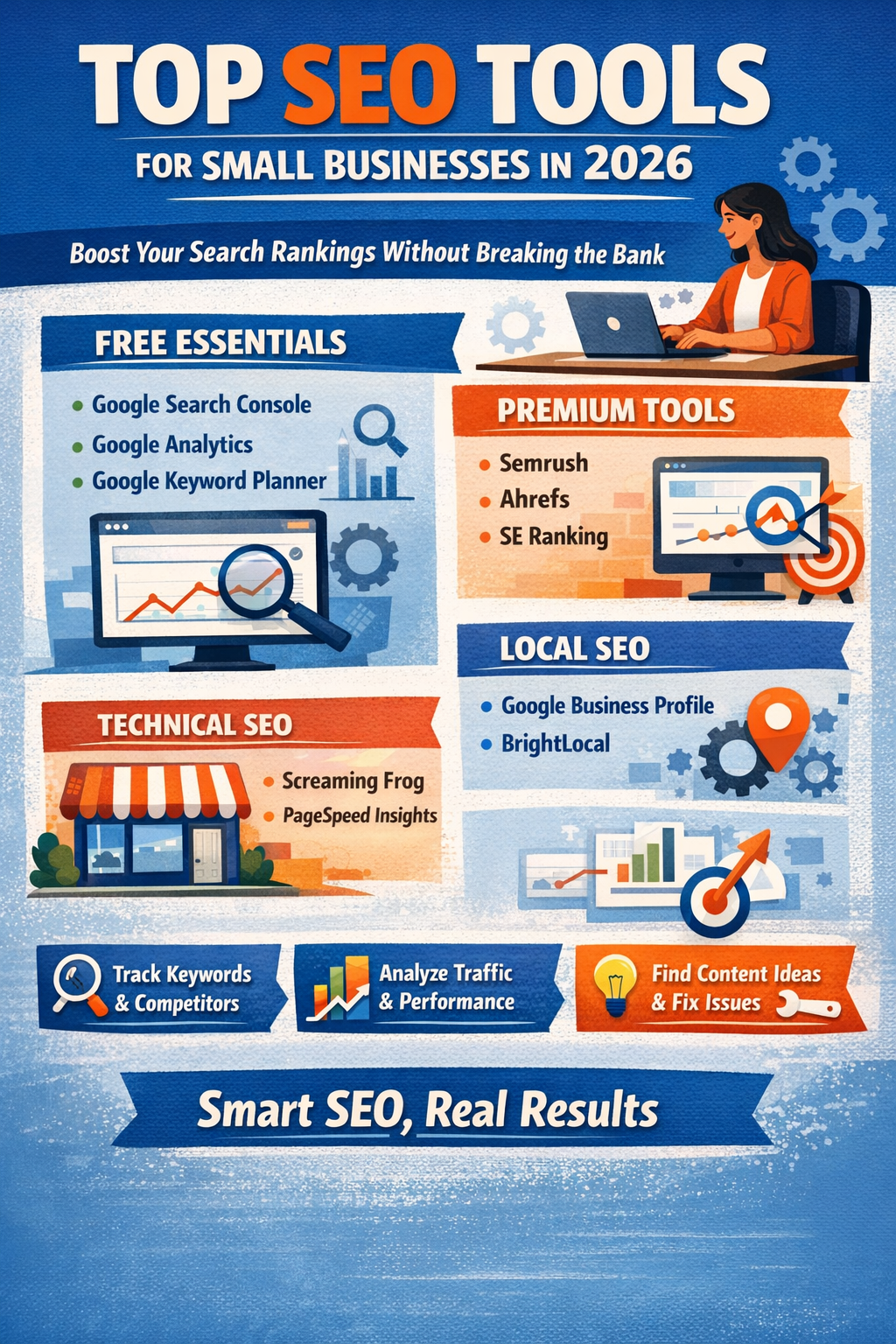
Start with the free essentials. Every small business needs Google Search Console and Google Analytics set up properly. Add Google Keyword Planner for basic keyword research. These three tools cost nothing and provide enough data to make real progress.
Evaluate paid tools based on your specific needs. E-commerce businesses benefit most from tools with strong product optimization features. Local service businesses need robust local SEO capabilities. Content-focused sites should prioritize keyword research and content optimization.
Consider your technical skill level honestly. Some platforms assume significant SEO knowledge. Others hold your hand with guided recommendations. Choose tools that match your comfort level to ensure you actually use them.
Budget appropriately for growth. Free tools work fine when starting. As revenue increases and SEO becomes a proven channel, investing in premium tools delivers clear ROI. Track the revenue generated from organic search to justify tool costs.
Don’t accumulate tools you won’t use. Five tools used consistently beat fifteen tools that sit idle. Master the basics with a few key platforms before adding specialized solutions.
According to SEO experts, winning at SEO in 2026 depends less on the specific tools you use and more on your ability to create content from genuine lived experience while understanding how search engines work.
Building the Perfect SEO Tools Stack for Small Businesses
A practical small business SEO stack might include Google Search Console for indexing and performance data, Google Analytics for traffic analysis, Google Keyword Planner for keyword research, and one premium platform like Semrush or SE Ranking for competitive intelligence and rank tracking.
Add Screaming Frog for monthly technical audits. Include a content optimization tool like Ubersuggest or Surfer SEO if you publish regularly. Local businesses should add Google Business Profile management through either native tools or a local SEO platform.
This combination costs between $0-200 monthly, depending on whether you choose free or paid options. The stack covers all critical SEO functions without overwhelming complexity or wasted features.
Use each tool consistently rather than constantly switching platforms. SEO improvements compound over time. Three months of consistent optimization with basic tools outperforms sporadic use of expensive software.
Review your toolkit quarterly. As your business grows, your tool needs evolve. What worked at launch may need upgrading as traffic increases and competition intensifies.
SEO Tools for Small Business Success in 2026 and Beyond
The SEO landscape continues evolving rapidly. AI-generated search results now appear for many queries, changing how users find information. Google’s algorithm updates favor genuine expertise and user value over manipulation tactics.
Small businesses actually benefit from these changes. AI search engines and Google both prioritize authentic, helpful content from real experts. Your lived experience and deep knowledge of your niche matter more than ever.
Success in 2026 requires combining the right tools with genuine value creation. Tools show you opportunities and track performance. But ranking long-term depends on creating content and experiences that truly help your audience.
Focus on consistency over perfection. Small weekly improvements accumulate into significant competitive advantages. Set up your core tools, establish a regular optimization routine, and commit to the process.
Need expert guidance on which tools best fit your business? Schedule a free consultation to discuss your SEO strategy and tool selection with our specialists.
The businesses winning at SEO don’t have the biggest budgets or fanciest tools. They have clear strategies, consistent execution, and genuine expertise. Your tools amplify your efforts, but your knowledge and commitment drive results.
Start simple, measure everything, and double down on what works. The right SEO tools for small business success aren’t the most expensive ones. They’re the ones you actually use to make data-driven decisions that grow your organic traffic and revenue.