Rankings no longer tell the whole story. A page can hold position one and still lose the click to an AI answer.
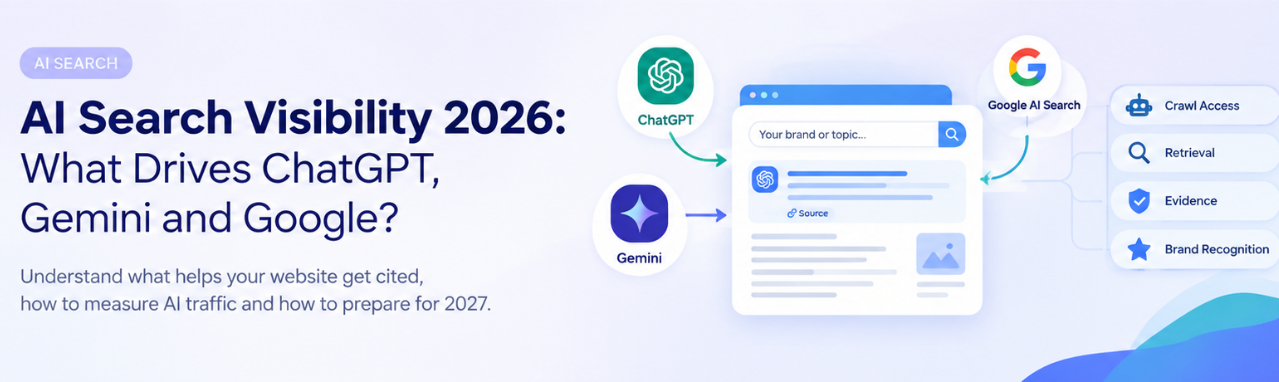
Website visibility in ChatGPT, Gemini, and Google AI Search now depends on whether machines can find, trust, and quote you.
That raises two practical questions. What actually earns a citation, and how do you prove the traffic is real?
This guide answers both using 2026 research and Google’s own documentation. You also get a measurement setup and a 2027 readiness plan you can start this week.
First, let us look at why the old playbook feels broken.
Why AI Search Changed the Rules of Visibility
Search behaviour has moved faster than most reporting dashboards. SparkToro reported that 68% of U.S. Google searches ended without a click in early 2026.
Ahrefs found that AI Overviews now cut the average click-through rate of top-ranking pages by 58%. That study covered 300,000 keywords, comparing December 2023 with December 2025.
The story is not only decline, though. Seer Interactive highlighted that click-through rate on AI Overview searches bottomed at 1.3% in December 2025 and rose to 2.4% by February 2026.
Citation changes the odds as well. In that same Seer data, pages cited inside an AI Overview earned roughly 2.1% CTR, while uncited pages earned about 0.9%.
Intent matters too. The same Seer dataset showed AI Overviews on about 95% of comparison queries but only about 5% of transactional ones.
Professionals who read these numbers together reach a clear conclusion. Visibility now has two currencies, which are clicks and mentions.
A brand named inside an answer shapes the decision before anyone opens a tab. A brand that is missing from the answer may never enter the shortlist.
This also explains why some businesses see flat rankings and falling sessions at the same time. Their pages still rank, but the answer layer absorbs the demand.
Local and high intent searches look more resilient. SparkToro’s findings, as summarised by TechWyse, noted that branded, local, and transactional queries remain less affected than informational ones.
That gives you a useful triage rule. Protect the queries that still send clicks, and earn citations on the ones that do not.
To do both well, you need to know how each platform selects its sources.
What Actually Drives Website Visibility in ChatGPT, Gemini, and Google AI Search
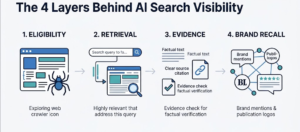
Each platform works differently, but the same four layers sit under all of them. Think of them as eligibility, retrieval, evidence, and recall.
Eligibility means the system can crawl and index your page. Retrieval means your page surfaces for the question or its sub-questions.
Evidence means your page contains facts the model can lift with confidence. Recall means your brand is familiar enough that the model names it unprompted.
Most teams only work on the middle two. The winners also invest in the first and last.
Layer one: eligibility and crawl access
Google is direct about the baseline. Its documentation says a page must be indexed and eligible to show with a snippet to appear as a supporting link in AI Overviews or AI Mode.
Google also adds that you do not need special AI files or new markup to qualify. Standard Search fundamentals apply.
For ChatGPT, check your robots.txt for rules that block search crawlers such as OAI-SearchBot or Bingbot. A blocked crawler cannot retrieve what it cannot reach.
Also review snippet controls. Tags such as nosnippet and max-snippet can reduce or remove your chances of appearing in AI features.
Many sites block crawlers by accident through old security plugins or staging rules. A quick audit often finds the problem in minutes.
Once access is confirmed, the next question is how ChatGPT actually chooses what to cite.
How ChatGPT picks its sources
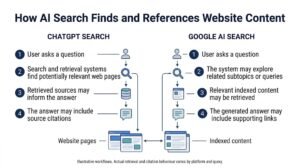
ChatGPT with browsing relies heavily on Bing’s index. Seer Interactive’s analysis, as summarised by 5W Research, found that 87% of SearchGPT citations matched Bing’s top 10 organic results, against 56% for Google.
That makes Bing visibility a quiet priority. If you ignore Bing Webmaster Tools, you ignore the index feeding ChatGPT search.
ChatGPT also names brands far more often than it links to them. The same 5W research put mentions at roughly 3.2 times citations.
A July 2026 B2B SaaS study from Position Digital reported that 66% of brand recommendations happened without ChatGPT citing the brand’s website. The sample was 278 responses, so treat it as directional.
That study linked citations to domain authority, organic performance, freshness, and entity richness. It linked recommendations to third-party listicles, branded web mentions, Reddit presence, and review volume.
The practical reading is simple. Your own site earns citations, but other people’s pages earn recommendations.
The same Position Digital data showed listicles, service pages, and documentation carrying 49.9% of citations. Commercial, well structured pages clearly have a role.
Now let us see how Google’s own systems differ.
How Gemini and Google AI features choose links
Google AI Overviews and AI Mode may use a technique called query fan-out. Google explains that the system issues multiple related searches across subtopics before writing a response.
This changes how you plan content. Your page may be retrieved for a sub-question you never targeted.
Google also notes that AI Mode and AI Overviews may use different models, so the links they show will vary. One tracking number cannot represent both.
Google has not published a Gemini specific citation checklist. Treat strong Search fundamentals as your working base for Gemini visibility.
A review of 27 studies noted that 76% of AI Overview citations came from the organic top 10 in July 2025. By March 2026, the review suggested that link had loosened.
So ranking helps, but it no longer guarantees inclusion. Coverage and credibility fill the gap.
Next, we will look at the signal that keeps surprising traditional SEOs.
Brand Signals Now Outweigh Backlinks in Many Studies
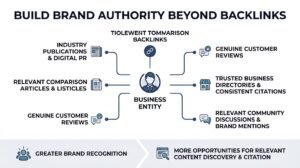
Several 2026 studies point away from link counts and toward brand strength. 5W Research cited brand search volume as the strongest known predictor of AI citation, with a 0.334 correlation.
A review of a 75,000-brand Ahrefs study reported that brand mentions correlated with AI Overview visibility at 0.664, about three times stronger than backlinks.
The same review described a Seer study of 62 brands in which the surviving signals were all off-site. They were industry publication coverage, community mentions, and branded search volume.
Correlation is not causation, and these samples skew toward certain industries. Even so, the direction is consistent across several methods.
This does not mean links are dead. Links still help pages rank, and ranking still feeds retrieval.
If you want a refresher, our guide on how backlinks work explains the fundamentals. Our walkthrough on building quality backlinks covers earning them responsibly.
What changes is the goal. You now want mentions in places that models and humans both trust.
Practical ways to build off-site brand presence
Start with the sources that already shape your category. Trade publications, comparison articles, and respected directories are common candidates.
Pitch useful data rather than promotional copy. Original numbers get quoted, and quotes become mentions.
Keep your business details consistent everywhere. Strong local citations in Ireland help machines confirm who you are and where you operate.
Maintain an accurate profile too. A complete Google Business Profile setup feeds the same entity picture that AI systems draw on.
Encourage genuine reviews and take part honestly in communities where your customers ask questions. Never fabricate threads or reviews, because platforms and models are getting better at spotting them.
Brand work is slow, which is why on-page quality still matters in the meantime. Let us turn to how you build pages that get quoted.
Build Pages That Machines Can Quote
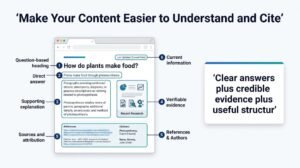
AI systems favour content they can lift cleanly. That does not mean writing for robots, but it does mean writing with precision.
Lead each section with the answer
Open every major section with a direct answer in the first one or two sentences. Then add context, evidence, and nuance.
This pattern serves human readers who scan, and it gives retrieval systems a clean passage to extract. Both audiences benefit.
Use headings that mirror real questions. “How long does local SEO take?” works better than a vague label like “Timelines”.
Our guide on how long SEO takes follows this approach, and it is a useful model to study.
Cover the fan-out, not just the keyword
Since AI features may split one question into several, your page should anticipate the sub-questions. Think definitions, comparisons, costs, steps, risks, and alternatives.
Do not publish a separate thin page for every possible sub-query. Build one comprehensive page, then support it with focused articles.
A solid business blog strategy helps you plan that cluster. Internal links then tie the cluster together so crawlers can find every piece.
Add evidence that cannot be copied
Generic summaries are easy for a model to produce, so they are rarely worth citing. Original data, screenshots, benchmarks, and first-hand lessons are harder to replace.
Show your experience. Real case studies with named methods and honest outcomes give both readers and models something specific to trust.
Add author names, credentials, and review dates. These are practical EEAT signals, and they help a reader judge whether to believe you.
Keep facts fresh and dated
Models and users both prefer current information. State the year beside any statistic, and update key pages on a schedule.
Replace outdated numbers instead of stacking new ones beside them. A clean refresh often beats a brand new post.
Write titles and descriptions that reflect the refreshed content. Our guide to meta titles and descriptions covers how to keep them accurate and clickable.
Strong content still needs a sound technical base underneath it.
Technical Foundations That Protect AI Visibility
Technical problems quietly cap AI visibility. If a page cannot be crawled, rendered, and indexed, no amount of good writing will surface it.
Run through this short checklist every quarter:
- Confirm key pages are indexed in Google and Bing.
- Submit XML sitemaps to both Google Search Console and Bing Webmaster Tools.
- Check that important content appears in the rendered HTML, not only after heavy scripts run.
- Review robots.txt and meta robots rules for accidental blocks.
- Keep internal links clear so crawlers reach deep pages.
Google recommends making content easy to find through internal links. This is one of the cheapest wins available.
Page speed and mobile usability still matter because they influence rankings and user satisfaction. Our overview of best technical SEO practices covers the full audit.
Structured data remains useful for clarity, even though Google says no special markup is required. Use accurate Organization, Article, and LocalBusiness markup where it fits.
With the foundations in place, you can turn to the question many clients now ask first. How do you prove any of this is working?
How SEOs Should Measure AI Traffic in 2026
AI measurement is messy because no single tool sees everything. The honest approach is to combine several partial views and label each one clearly.
Know what each tool can and cannot see
| Surface | Where it appears | Main limit |
| ChatGPT, Perplexity, Gemini app, Copilot | GA4 referral or AI Assistant channel | Undercounts, since some visits lack referrers |
| Google AI Overviews and AI Mode | Search Console impressions report and Organic Search in GA4 | Impressions only, no click split |
| Copilot and Bing answers | Bing Webmaster Tools AI Performance | Covers Bing ecosystem only |
| Untracked visits | Direct traffic and server logs | Cannot be attributed with certainty |
Keep this table in your reporting notes. It stops stakeholders from mistaking one tool’s limits for the whole picture.
Set up AI referral tracking in GA4
GA4 includes an AI Assistant channel for sources such as ChatGPT, Gemini, Copilot, and Grok. Analytics documentation, as described by Target Internet, says it excludes Google AI Overviews and AI Mode.
Order matters in channel rules. GA4 applies the first matching condition, so place your AI rule above Organic Search and Referral.
If you prefer a custom channel group, use a regex covering chatgpt.com, perplexity.ai, claude.ai, gemini.google.com, and copilot.microsoft.com. Review the list every few months as new tools appear.
Expect undercounting. One analysis observed that ChatGPT desktop began appending a utm_source parameter in June 2025, while mobile app and copy-paste visits remain largely invisible.
Treat GA4 AI numbers as a floor, never a ceiling. Report them as “identified AI sessions” to keep the wording honest.
Use the Search Console generative AI report
Google introduced generative AI performance reports in Search Console in June 2026. NoGood explained that the report shows impressions only, with no clicks, queries, or API access.
Clicks from AI Overviews and AI Mode have also been flowing into normal Web search totals. The same NoGood analysis stresses that there is no separate AI Mode filter in the standard Performance report.
Use the report to see which pages appear in AI features. Then compare those pages against GA4 landing page performance.
If you are new to the tool, start with our primer on what Google Search Console is. A clean property setup makes every later comparison easier.
Use Bing Webmaster Tools AI Performance
Microsoft announced AI Performance reporting in Bing Webmaster Tools in February 2026. It offers the most direct citation data currently available from a major platform.
Because ChatGPT search leans on Bing’s index, strong Bing visibility is a useful proxy for retrieval chances. It is not proof of ChatGPT citations, so label it carefully.
Check the report monthly. Citation counts can shift noticeably after a content refresh.
Read server logs and the direct bucket
Server logs show which crawlers reach your pages and how often. Spikes or gaps in AI crawler activity can explain sudden visibility changes.
Watch the direct channel as well. AI assistant visits without referrers often land there, so a rising direct trend alongside new citations is worth investigating.
Add a simple “how did you hear about us” field to forms. Self-reported attribution catches AI influence that analytics cannot.
Track visibility with a fixed prompt set
Build a list of 25 to 50 prompts that match your buyers’ real questions. Run them on a schedule across ChatGPT, Gemini, and Google AI Mode.
AI answers vary from run to run, so sample each prompt several times. Report ranges and trends rather than single results.
Record three things for each prompt. Note whether your brand was mentioned, whether your page was cited, and which competitors appeared.
Paid tracking tools can automate this, but a spreadsheet is enough to begin. Consistency matters more than tooling.
Connect AI visits to outcomes
Traffic only matters if it leads somewhere. Compare AI sessions with organic sessions on engagement, lead rate, and revenue.
Small samples can mislead, so avoid bold claims in the first few months. Look for patterns over a quarter instead.
Landing page quality affects conversion regardless of source. Our conversion rate optimisation tips help make sure cited pages actually turn visits into enquiries.
Now let us pull these measurements into one reporting view.
An AI Visibility Scorecard You Can Reuse
A scorecard keeps reporting simple for clients and managers. Group metrics into five layers, from access to outcomes.
| Layer | Example metrics | Source |
| Eligibility | Indexed pages, crawl errors, bot access | Search Console, Bing, logs |
| Visibility | AI feature impressions, Bing citations, prompt mentions | Search Console, Bing, prompt tests |
| Traffic | Identified AI sessions, AI landing pages | GA4 |
| Outcomes | Leads, calls, revenue from AI sessions | GA4, CRM |
| Brand | Branded search trend, third-party mentions | Search Console, mention tools |
Review the scorecard monthly and discuss it quarterly. Short cycles create noise, while long cycles hide problems.
Pair it with a clear note on limits. Clients trust reports that admit what they cannot see.
The scorecard also helps you spot mismatches. High impressions with low clicks suggest a snippet or intent problem, while low impressions suggest a retrieval problem.
With measurement in place, you can plan the year ahead.
How to Prepare for 2027
No one can forecast AI search precisely, so plan around trends rather than predictions. Several are already visible.
First, AI Mode may take a larger share of searches. SparkToro’s January to April 2026 data, as reported, suggested AI Mode played a limited role then but could matter far more if usage keeps growing.
Second, reporting is improving. Google moved from no dedicated AI reporting to an impressions report within a year, and Bing now offers citation data.
Expect richer data over time, but build your process now. Early baselines will be valuable when better metrics arrive.
Third, queries without AI Overviews are becoming more valuable. Seer found that CTR on those searches rose from 2.8% in early 2025 to 3.8% by February 2026.
Users who still click tend to want depth, tools, or proof. That favours specialised, differentiated content.
A 90 day readiness plan
Use this sequence to get moving without overwhelming your team:
- Days 1 to 30: Audit crawl access, set up the GA4 AI channel, connect Bing Webmaster Tools, and build your prompt list.
- Days 31 to 60: Refresh your ten most important pages with answer-first sections, dated facts, and original evidence.
- Days 61 to 90: Launch an off-site plan covering digital PR, directories, reviews, and community participation.
- Ongoing: Report the scorecard monthly and refresh top pages every quarter.
Keep expectations realistic. Brand and authority signals build slowly, much like traditional SEO, so a patient roadmap beats a rushed one.
Local strategy deserves its own attention, so let us look at the Irish market next.
What This Means for Irish and Local Businesses
Local queries tend to hold up better against zero-click pressure. That gives Irish service businesses a real opportunity right now.
Accurate business profiles, consistent citations, and genuine reviews feed both Google and the wider web. Those same signals help AI systems name you for “near me” and city specific questions.
If you serve a regional market, local SEO remains the foundation. Cities such as Dublin reward focused pages and strong profiles, as our Dublin local SEO work shows.
Our broader digital marketing trends for Ireland in 2026 explain how these shifts affect budgets and priorities. It is a helpful companion read for planning.
At DigiWizard, we help Irish businesses prepare for answer engines through our AEO services. That work sits alongside core SEO so rankings and citations grow together.
If you want the strategic view first, read our explainer on generative engine optimisation. It breaks down the concepts in plain language.
Our SEO strategies for Irish businesses guide adds practical priorities for smaller teams. Use it to decide where to start.
Authority still counts as well. If you want context on how it fits in, our piece on domain authority explains what the metric does and does not tell you.
Let us close by pulling everything into a clear next step.
Conclusion
Website visibility in ChatGPT, Gemini, and Google AI Search comes from four things working together. Your pages must be accessible, retrievable, quotable, and backed by a brand people already mention.
Measurement completes the loop. Combine GA4, Search Console, Bing Webmaster Tools, logs, and a fixed prompt set, and be honest about what each one misses.
The 2027 winners will not be the loudest brands. They will be the ones that built clean foundations, earned trusted mentions, and tracked progress while others guessed.
Start this week. Fix crawl access, set up your AI channel, and refresh one page so it answers its main question in the first two sentences.
FAQ
What drives visibility in ChatGPT?
ChatGPT search leans on Bing’s index, so Bing rankings, crawl access, and fresh, fact-rich pages help. Third-party mentions, reviews, and listicles also influence which brands it recommends, often without linking to your site.
Do I need special schema or an llms.txt file for Google AI features?
Google’s guidance says no special markup or AI text files are required. Pages must be indexed and snippet eligible. Accurate structured data still helps clarity, but it is not a requirement for inclusion.
How can I track ChatGPT traffic in GA4?
Use GA4’s AI Assistant channel or a custom channel group matching domains like chatgpt.com. Place the rule above Referral and Organic Search. Expect undercounting, because some mobile and copy-paste visits arrive without referrers.
Can Search Console show clicks from AI Overviews and AI Mode?
Not separately. Clicks are included in normal Web search totals, while the generative AI report introduced in June 2026 shows impressions only, without clicks, queries, or API access.
Are backlinks still worth building?
Yes, but they are not the whole picture. Links support rankings, and rankings support retrieval. Several 2026 studies also found off-site brand mentions and branded search correlating strongly with AI citations, so balance both.
How long does it take to appear in AI answers?
It varies by competition and authority. Technical fixes and page refreshes can show movement within weeks, while brand mentions and trust signals typically build over months. Track trends quarterly rather than expecting instant results.
Want to know where your site stands in ChatGPT, Gemini, and Google AI Search?
Book a free consultation and we will review your AI visibility, tracking setup, and quickest wins, with no obligation.