
Search behaviour is changing, and SEO reporting needs to change with it. People increasingly use conversational AI tools to research services, compare providers, understand complex topics, and discover businesses before visiting a website.
For SEO professionals, the challenge is not simply getting a website mentioned in an AI-generated answer. It is understanding whether that visibility brings qualified visitors, influences buying decisions, and contributes to business growth.
Google has introduced dedicated generative AI performance reporting in Search Console, while Microsoft has expanded AI citation reporting in Bing Webmaster Tools. These developments make AI visibility more measurable than it was previously, although important gaps remain. Google’s Search Central announcement and Microsoft’s AI Performance documentation explain the available reporting capabilities.
As 2027 approaches, successful SEO teams will need a measurement framework that combines traditional organic performance, AI citations, referral sessions, conversions, and revenue. The goal is to understand the complete customer journey, not to chase a new visibility metric without knowing its commercial value.
What AI Traffic Actually Means in Modern SEO
Before building a dashboard, you need to establish exactly what your team means by AI traffic. Different forms of AI activity generate different data, and combining them into a single number can produce misleading conclusions.
AI referral traffic
AI referral traffic consists of visits to your website that analytics tools attribute to an AI platform or conversational assistant.
For example, someone asks ChatGPT to recommend an SEO agency in Ireland, follows a source link in its response, and lands on your service page. If the referral information is preserved and your analytics system captures the visit, that session may appear as traffic from ChatGPT.
Similar visits can originate from Perplexity, Microsoft Copilot, Google-related AI experiences, and other services. The exact reporting depends on how the visitor reaches your site and how the platform passes referral information.
This is the most straightforward form of AI traffic to measure because it involves an observable website visit.
AI search visibility and citations
A second category is AI visibility. Your website or brand may appear in an AI-generated answer without the user clicking through to your website.
Suppose a business owner asks an AI assistant to compare local SEO agencies in Dublin. The assistant mentions your agency and cites one of your service pages, but the user continues the conversation without visiting your site.
That exposure may influence brand recognition or a later enquiry, but it does not necessarily generate a measurable analytics session.
This distinction matters because a website can gain AI citations without experiencing a corresponding increase in referral traffic. Conversely, referral visits can increase even if the SEO team has not tracked the underlying visibility.
AI crawler and agent activity
AI-related server activity is another category, but it should not be confused with human visits.
Automated systems may crawl pages to retrieve information, support search features, or perform tasks on behalf of users. These requests can appear in server logs without producing a normal analytics session.
Adobe’s technical guide to analysing conversational AI traffic distinguishes different types of AI activity, including retrieval, training-related collection, and agentic workflows.
For SEO reporting, maintain separate categories for human referrals, AI citations, and automated requests. Once these definitions are clear, you can choose the right measurement tools for each category.
The Three Layers of AI Traffic Measurement
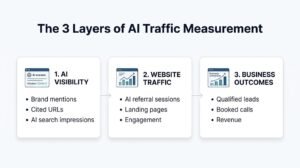
A practical AI SEO measurement framework should answer three different questions: Are you visible? Are people visiting? Are those visits producing business outcomes?
Layer one: Visibility
Visibility measurement examines whether AI-powered search experiences mention or cite your website and brand.
Useful indicators include cited URLs, citation frequency, the types of questions associated with your citations, and your presence across relevant topics.
For a local SEO agency, visibility might involve appearing in answers to questions such as:
- Which local SEO agency serves businesses in Galway?
- How can a roofing company in Cork improve Google Maps visibility?
- What should an Irish small business look for in an SEO agency?
- Which SEO services help generate qualified local enquiries?
These are examples of monitoring questions, not verified search volumes or evidence that any specific platform currently recommends DigiWizard.
Visibility metrics help you understand whether your content is represented in relevant conversations, even when no click occurs.
Layer two: Website visits and engagement
The second layer measures visits that analytics systems can attribute to AI sources.
Track sessions, engaged sessions, landing pages, engagement rate, and returning visits. Segment these metrics by platform whenever the available source data supports it.
This helps you discover whether AI-referred visitors land on educational articles, service pages, case studies, or contact pages.
It also reveals whether your website gives those visitors enough information to take the next step.
Layer three: Leads, sales, and revenue
The third layer connects AI discovery to meaningful outcomes.
For a service business, these outcomes may include completed consultation forms, qualified enquiries, booked calls, telephone leads, and signed contracts.
For an online shop, they may include purchases, revenue, average order value, and repeat purchases.
This final layer is what turns AI traffic reporting into a business decision-making tool. With the measurement layers established, the next step is to collect the data consistently.
How to Measure AI Traffic Using Google Analytics 4
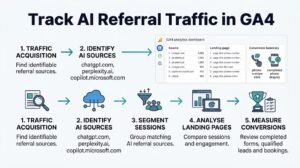
Google Analytics 4 is a sensible starting point for tracking identifiable AI referral sessions because it connects traffic acquisition with website engagement and conversion events.
Google’s official Traffic acquisition report documentation explains how to examine session sources, mediums, engagement, and key events.
Step one: Open the Traffic acquisition report
Sign in to GA4 and navigate to Reports, then Acquisition, then Traffic acquisition.
This report helps you investigate which sources are bringing people to your website and how those sessions perform.
Select a consistent reporting period, such as the previous 28 days, and compare it with the preceding period. For strategic reporting, also review monthly and quarterly trends.
Do not compare periods without accounting for differences in seasonality, campaign activity, website changes, or tracking implementation.
Step two: Identify AI referral sources
In the report, examine the Session source and Session source / medium dimensions.
Look for recognisable AI-related sources, including:
- chatgpt.com
- perplexity.ai
- copilot.microsoft.com
- Other identifiable AI assistant domains appearing in your actual data
These are examples to investigate, not a complete or permanent list of every AI referral source.
Domains and referral behaviour can change. Some experiences may pass a recognisable referrer, while others may not.
Create a documented list of the source values that appear in your property. Update it periodically rather than assuming that a static list will capture every AI platform.
Step three: Build an AI referral segment
Create a comparison that isolates identifiable AI sources from other sessions.
Depending on your GA4 configuration, you can use a comparison, exploration, or report filter to include matching source values. A regular expression can help group several sources into one segment.
For example, a simple illustrative expression could be:
(chatgpt\.com|perplexity\.ai|copilot\.microsoft\.com)
This is a starting point, not a comprehensive production-ready expression. Test it against your actual source values and expand it as needed.
Keep a separate segment for unknown or unattributed traffic. Do not classify every direct session as AI traffic simply because the visitor may have used an AI assistant earlier.
Step four: Examine landing pages
Add landing page or page path information to your analysis.
You may find that AI-referred visitors enter through detailed guides rather than your homepage. Others may arrive directly on a service page or a case study.
For each landing page, compare the number of sessions with engagement and key events.
A page receiving 20 relevant AI referral sessions and generating three qualified enquiries may deserve more attention than a page receiving 100 sessions without meaningful engagement. These numbers are hypothetical, but the principle is important: evaluate traffic quality alongside traffic volume.
Step five: Track meaningful conversions
Configure GA4 key events for actions that represent real business value.
For a service-based business, these might include a successfully submitted consultation form, a completed lead form, or a confirmed booking.
A click on a telephone number can also be tracked, but it should not automatically be counted as a completed telephone enquiry. Similarly, a form submission is not necessarily a qualified lead.
If your CRM records lead quality and closed sales, connect those records to your reporting process where feasible and lawful.
Step six: Investigate unattributed visits
Google explains in its documentation on direct traffic that missing referral information, redirects, and links without appropriate campaign parameters can cause sessions to appear as direct traffic.
AI discovery can be difficult to attribute when a visitor copies a URL, switches devices, returns later, or encounters an application that does not pass referral information.
Review redirect chains, analytics configuration, consent behaviour, and landing-page tracking before drawing conclusions from an unexpected increase in direct traffic.
GA4 provides the foundation for measurable referrals, but it cannot reveal every AI-generated impression. That is why AI visibility reporting must complement website analytics.
How to Track AI Search Visibility in Google Search Console
AI visibility and AI referral traffic are different measurements. Google Search Console is particularly useful for examining the former within Google’s supported search experiences.
Google announced its Search Generative AI performance reports in June 2026 and reported worldwide rollout of the insights by 31 August 2026.
The available reporting covers impressions from generative AI features in Google Search and Discover, including supported AI search experiences. Availability and the exact information shown should always be checked within the property’s current Search Console interface.
Review AI impressions over time
Open the relevant generative AI performance report and select a consistent date range.
Review whether reported impressions are rising, falling, or remaining stable. Compare the trend with changes to published content, page updates, technical fixes, and overall search performance.
An increase in AI impressions suggests that your pages are appearing more frequently in the report’s supported AI features. It does not, on its own, prove that users clicked through or that those impressions produced more sales.
Identify the pages receiving visibility
Review the URLs appearing in the report.
Group them by content type, such as service pages, location pages, educational articles, product pages, and case studies.
This analysis can reveal which types of content receive AI exposure and where additional content may be useful.
For instance, if a detailed article about local SEO attracts AI impressions but your local SEO service page receives little visibility, investigate whether the service page clearly explains its audience, deliverables, expertise, and relationship to the supporting article.
Do not assume that every low-impression page needs rewriting. Search demand, eligibility, query relevance, and reporting thresholds may all affect the data.
Segment by country, device, and date
Use available country, device, and time dimensions to investigate where your reported visibility originates.
For an Irish business, check whether visibility aligns with the intended market. An increase in global exposure may be less commercially valuable than improved visibility among potential customers in Ireland.
Review the dates of major changes and annotate them in your reporting sheet. This creates a useful record for evaluating future content and technical work.
Compare AI visibility with traditional organic performance
Examine the corresponding pages in your standard Search Console performance reports.
Compare AI impressions with traditional search impressions, clicks, click-through rates, and average positions where available.
The relationship is more informative than any individual number. AI impressions may increase while website clicks remain flat, or a page may receive more clicks despite relatively stable reported AI visibility.
These patterns suggest different opportunities. A visibility increase without additional visits may call for better value propositions, stronger conversion paths, or closer examination of how users discover the brand outside measurable clicks.
Because Google’s reporting reflects its supported AI features rather than every AI assistant on the internet, you should also examine citation data from other platforms.
How to Measure AI Citations With Bing Webmaster Tools
Bing Webmaster Tools has become an important part of AI search reporting because it provides visibility data that ordinary website analytics cannot supply.
Microsoft introduced its AI Performance public preview on 10 February 2026. According to the official announcement, the report helps publishers understand how their content is cited across Microsoft Copilot, AI-generated summaries in Bing, and selected partner experiences.
Measure total citations
The Total Citations metric counts citations of your content in supported AI-generated answers during the selected period.
Use it to understand whether your content is being referenced more or less frequently.
However, a citation count is not equivalent to a traditional ranking position, a website visit, or a conversion. One page can be cited frequently without generating many clicks, and an increase in citations does not automatically indicate a stronger commercial outcome.
Examine average cited pages
Average Cited Pages indicates the average number of unique pages from your site cited per day during the selected period.
This metric helps you determine whether AI visibility is concentrated in a few articles or distributed across a broader collection of pages.
If citations are concentrated on one guide, consider whether related service pages, supporting research, and useful examples adequately address the same subject.
If multiple pages receive citations across different themes, examine what they have in common. They may provide clearer explanations, stronger evidence, more complete answers, or better alignment with the questions users ask.
Treat these as hypotheses to investigate rather than guaranteed ranking factors.
Analyse grounding queries
Grounding queries describe phrases associated with the information used to generate AI answers.
These phrases can help you understand the context in which your pages are cited. They may reveal commercial questions, troubleshooting needs, informational topics, or local discovery opportunities.
Use them to improve content planning and identify unanswered questions.
For example, an Irish SEO agency might discover that its content is associated with questions about local visibility, Google Business Profile management, or the cost of SEO services.
The practical response is to check whether the relevant page gives a useful, accurate, and commercially appropriate answer.
Microsoft’s AI Performance documentation explains the available metrics and their limitations. Use those definitions when documenting your own dashboard, because citation data should not be interpreted as a complete record of every AI conversation.
How to Monitor ChatGPT, Perplexity, Gemini, and Copilot
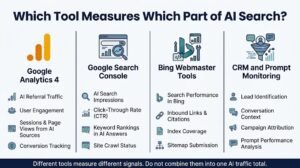
A common reporting mistake is to treat every AI platform as if it offers the same visibility metrics.
In practice, measurement methods differ between platforms. Some provide identifiable website referrals, some provide dedicated citation reporting, and some require manual or third-party observation to investigate brand visibility.
Build a measurement matrix instead of expecting one dashboard to provide every answer.
| Platform or source | What to measure | Main limitation |
| ChatGPT | Identifiable referral sessions, landing pages, leads | Referral data does not capture every mention |
| Perplexity | Referral sessions and available citation observations | Visits represent only part of visibility |
| Microsoft Copilot | Bing AI Performance citations and identifiable referrals | Citation coverage depends on supported surfaces |
| Google AI search features | Search Console generative AI impressions and available referral data | Impressions are not equivalent to visits |
| Other AI assistants | Recognisable referrals and documented visibility checks | Reporting availability varies by platform |
Create a consistent prompt monitoring list
Choose a small set of commercially relevant questions and review them periodically.
For example, a local SEO agency might track questions about finding an SEO provider, comparing service options, choosing an agency for a particular industry, and solving a specific local ranking problem.
Keep the question wording consistent across review periods where possible.
Record the date, platform, question, whether the brand appears, cited URLs, competitor mentions, and the apparent context of each mention.
Where available, capture the source links so you can verify whether the assistant actually cited your page.
Make observations repeatable
AI responses can vary according to query wording, location, language, account context, model version, and other factors.
One successful appearance does not establish consistent visibility. Likewise, one missing mention does not prove that your brand is absent from the platform entirely.
Use repeated observations and clearly label manually checked results as samples.
Do not present a small collection of prompt tests as an exhaustive measure of your share of AI search.
Separate brand mentions from source citations
A brand mention and a source citation are not the same thing.
An AI assistant may recommend a business by name without linking to its website. It may also cite a page without prominently naming the company that published it.
Track these separately because they provide different insights into brand recognition and the visibility of owned content.
Once your platform-level reporting is consistent, you can identify which metrics deserve the most attention in 2027.
Which AI SEO Metrics Matter Most in 2027?
There is no single AI visibility metric that can adequately represent the success of an SEO campaign.
The strongest measurement framework combines discovery, website behaviour, conversion performance, and business outcomes. It also keeps traditional SEO metrics in the picture.
AI citation frequency
Track citations from reporting systems that provide them, alongside the URLs and topics associated with those citations.
A rising citation trend may indicate that your content is being referenced more often within supported AI experiences.
Assess the trend by topic and landing page rather than relying exclusively on an account-wide total.
AI visibility rate
You can calculate an internal visibility rate from a defined set of repeatable monitoring questions:
VisibilityRate=QuestionswithaBrandMentionQuestionsTested100
Suppose your team tests 40 relevant questions and finds your brand in 12 responses.
Your observed visibility rate would be 30%.
This is a measurement of your specific test set, not a universal share of all AI search activity. Make the sample size, platforms, geography, and review method clear in reports.
AI referral sessions
Measure identifiable sessions from AI sources and compare them with previous periods.
Use landing-page segmentation to distinguish educational traffic from visits to commercial pages.
A rise in AI referral sessions is useful evidence of measurable visits, but it does not establish how many additional customers the website acquired because of AI.
Engagement quality
Review engaged sessions, engagement rate, average engagement time, and meaningful next-step actions.
Avoid assuming that longer sessions are inherently better. A user who finds a telephone number immediately may convert quickly, while another may spend several minutes reading without taking action.
Interpret engagement alongside the purpose of each landing page.
AI-assisted conversions
Track leads and sales from identifiable AI referral sessions where attribution data supports the connection.
For service businesses, distinguish between an initial form submission and a qualified lead.
For e-commerce businesses, measure completed purchases and associated revenue rather than relying only on product page visits.
AI-influenced conversions
Some customers may discover a brand through AI and later return through direct traffic, organic search, paid advertising, or a branded search.
These journeys are harder to attribute to AI.
Where practical, use CRM source fields, customer questionnaires, and consented analytics data to investigate assisted discovery.
Keep directly observed conversions separate from inferred or self-reported AI influence. This distinction improves the credibility of your reporting and prevents inflated claims.
Topic coverage and commercial relevance
Measure whether AI visibility covers the subjects that matter to your business.
A company selling professional services may gain more value from appearing in answers about selecting a provider, comparing solutions, or evaluating costs than from being mentioned in unrelated informational conversations.
Map the visibility data to your priority services and target customers. With those metrics defined, the next task is to connect them to measurable business value.
How to Connect AI Traffic With Leads, Sales, and Revenue
AI SEO reporting becomes commercially useful when it shows how discovery relates to enquiries, purchases, and customer acquisition.
A traffic report alone cannot tell a business owner whether an SEO campaign is generating worthwhile opportunities.
Set up conversion events that reflect business goals
For a local service business, define the actions that matter before building your report.
Examples include a completed consultation request, a submitted quotation form, a confirmed appointment, or a tracked telephone enquiry.
Where a website records button clicks, distinguish those events from completed actions. A click on a booking button does not necessarily mean the booking succeeded.
For e-commerce, use validated purchase events with the appropriate transaction value and currency.
Calculate the conversion rate for AI referrals
A basic session-based conversion rate is:
ConversionRate=ConvertingAISessionsTotalAISessions100
Suppose your website records 200 identifiable AI referral sessions and six sessions generate a qualified lead.
Your session-based lead conversion rate is 3%.
This example illustrates the calculation, not a benchmark for AI traffic performance. A small sample can produce large percentage changes, so review the underlying counts before making decisions.
Estimate the cost of acquiring an AI-attributed lead
If your organisation has identifiable costs associated with content production, analytics, and AI SEO work, you can calculate an operational cost per lead.
For example, divide the agreed campaign cost by the number of qualified leads attributed under your documented measurement rules.
Be careful when interpreting the result. An SEO campaign may support both AI visibility and conventional organic search, making it difficult to assign every cost to one channel.
For more reliable financial reporting, document the cost allocation method and compare it with the same method over time.
Measure lead quality and closed revenue
Not every enquiry has equal value.
A local SEO agency might receive enquiries from businesses outside its service area, people seeking free advice, or prospects whose requirements do not match the agency’s services.
Track qualified leads, sales conversations, proposals, signed clients, and revenue wherever your CRM supports those stages.
This allows you to determine whether AI-referred enquiries resemble those from other channels in quality and commercial value.
Use customer feedback to identify missing attribution
Include an optional question in your enquiry process, such as: “How did you first hear about us?”
Offer AI assistants as a response option where relevant, alongside search engines, referrals, social media, and other channels.
This information is self-reported rather than definitive attribution. Customers may have encountered your business through multiple sources or may not remember the first interaction.
Still, it can provide useful evidence when analytics shows few AI referrals but customers report using AI assistants during their research.
A combined measurement approach provides a more realistic view of commercial impact than referral analytics alone.
Why AI Traffic Measurement Is Often Incomplete
Even a carefully configured analytics system cannot capture every interaction that influences a customer’s decision.
Understanding these limitations is essential before you use AI traffic data to change budgets, content strategy, or client reporting.
AI discovery does not always produce a referral
Someone may read an AI-generated answer, remember your brand, and search for your company several hours later.
GA4 may record the eventual visit as organic search or direct traffic rather than an AI referral.
The AI interaction may have influenced the decision, but the analytics record does not necessarily preserve that connection.
Some AI interactions happen without website visits
An AI assistant can answer a question using information from several sources without the user opening those sources.
In that situation, your content may contribute to discovery without generating a website session.
Do not interpret a lack of referral sessions as proof that your content has no AI visibility. Use supported citation reports and carefully documented observation methods to investigate the wider picture.
Consent and browser behaviour affect reporting
Consent choices, browser restrictions, privacy tools, redirects, and application behaviour can affect the data available to analytics systems.
Review your consent configuration and ensure that your tracking practices comply with applicable privacy requirements.
For businesses operating in Ireland, review relevant guidance from the Data Protection Commission on cookies and similar technologies.
Do not attempt to overcome privacy restrictions by collecting information without an appropriate legal basis.
Small datasets create misleading conclusions
A website receiving only a few AI referral sessions each week may experience substantial percentage changes from a very small number of additional visits.
An increase from five sessions to ten represents 100% growth, but it is only five additional sessions.
Always report the underlying counts alongside percentage changes. For low-volume websites, combine quantitative reporting with qualitative evidence from customer enquiries and repeated visibility checks.
Platform reports have different scopes
Citation counts, impressions, sessions, users, and conversions are not interchangeable.
One platform may report a cited URL, another may report a referral session, and a third may offer no equivalent metric.
Do not add these figures together into a single total called “AI traffic.” Present them as separate indicators and explain what each measures.
With these limitations understood, your next priority is improving the quality of the data and the content that generates discoverability.
How to Prepare Your Website for AI Search in 2027
Preparing for 2027 does not mean abandoning traditional SEO or producing large quantities of content for AI systems.
It means building a website that search engines and AI-assisted discovery systems can access, interpret, and associate with reliable information about your business.
Strengthen your technical SEO foundation
Start with the fundamentals.
Ensure important pages return the correct HTTP status codes, internal links work, canonical tags are appropriate, and search engines can access the content you intend to make discoverable.
Maintain an accurate XML sitemap and investigate indexing problems in Search Console.
Review mobile usability, page speed, and Core Web Vitals because these affect the experience of people visiting your website, even though no individual performance metric guarantees an AI citation.
DigiWizard’s guide to technical SEO best practices provides a relevant starting point for reviewing these foundations.
Write content that answers real questions
AI discovery is not a substitute for understanding what potential customers need.
Research the questions people ask before choosing a product or service, then create pages that answer those questions directly and thoroughly.
A strong page should explain the problem, the available options, the decision criteria, and the circumstances in which a particular solution makes sense.
Use specific examples and relevant qualifications rather than filling paragraphs with repetitive keyword variations.
For a practical content workflow, review DigiWizard’s guidance on writing SEO content for Google and AI search.
Demonstrate first-hand experience
Generic summaries are easy to reproduce and rarely explain why a particular business deserves consideration.
Strengthen your content with original insights, documented processes, genuine case studies, and examples drawn from actual client work.
If you claim that a campaign improved local visibility, explain what was measured, the period covered, the work performed, and the limitations of the evidence.
Do not invent results, customer testimonials, rankings, or revenue improvements to make a page more persuasive.
Where suitable, identify the author or reviewer and provide information about their relevant experience. Keep biographies and credentials accurate.
Make your entities and services clear
Your website should make it straightforward to understand who your business is, what it offers, whom it serves, and where it operates.
Use consistent company details across relevant pages and directories.
Explain the relationship between your organisation, its services, its team, its case studies, and its location pages.
For example, an Irish SEO agency should clearly distinguish its general SEO services from location-specific services and industry-specific expertise.
Structured data can help communicate information in a machine-readable format when it accurately reflects visible page content. However, adding schema does not guarantee that an AI system will cite or recommend your business.
Build useful topical depth
A single article rarely addresses every question a potential customer has about a complex service.
Build a connected set of pages that covers the subject from multiple relevant angles.
For a local SEO agency, this might include a core local SEO service page, Google Business Profile guidance, keyword research, review management, technical SEO, and relevant case studies.
Link these pages together where the relationship genuinely helps the reader.
Avoid creating dozens of near-identical pages that differ only by town name. Each location page should provide useful local context and clearly explain the service available in that area.
Keep information accurate and current
Review pages that contain outdated prices, service details, regulations, screenshots, or statistics.
Update them when material information changes, and make sure the published content reflects the actual business offering.
Adding a new date to an unchanged article does not make the information more reliable.
Use primary sources for important claims and preserve the source links needed to verify them. This makes the content more trustworthy for readers and easier for your team to maintain.
Improve your website’s conversion experience
AI visibility has limited business value if visitors cannot understand your offer or take the next step.
Make service descriptions specific, explain the engagement process, show genuine evidence of expertise, and provide a clear way to enquire.
Review mobile forms, telephone links, navigation, and the placement of consultation options.
DigiWizard’s guide to improving website user experience and conversions offers a useful companion resource.
A website prepared for AI discovery should also work well for visitors arriving from every other channel.
Local SEO and AI Search: What Irish Businesses Should Track
Local businesses have an additional measurement challenge because AI-assisted discovery may involve location, service availability, reviews, and business information rather than a single website page.
An SEO team should connect AI visibility with the local search signals it can actually observe.
Maintain an accurate Google Business Profile
Keep your business name, address or service area, telephone number, hours, categories, and services accurate.
Ensure the website linked from your profile matches the business information and provides a useful destination for prospective customers.
Google Business Profile reporting can help you monitor available interactions such as website clicks, calls, and direction requests.
These metrics are useful for local marketing, but they do not establish that an interaction originated from an AI-generated recommendation.
Monitor reputation and review quality
Encourage genuine customers to share honest feedback in accordance with the platform’s policies.
Respond professionally to reviews and use recurring feedback to improve your services.
Do not buy reviews or condition incentives on receiving positive ratings.
Reviews can help prospective customers evaluate a business, but the effect of any particular review strategy on AI recommendations should not be assumed without evidence.
Connect local visibility with real enquiries
A business may receive fewer website visits while generating more telephone enquiries, or it may gain visibility in a wider geographic area without attracting suitable customers.
Review website conversions alongside calls, consultation bookings, qualified leads, and the geographic suitability of enquiries.
For Irish businesses, DigiWizard’s local SEO services provide a relevant starting point for evaluating local search strategy.
If your business serves a specific region, compare the available evidence with the service areas that matter commercially. This helps you prioritise useful local visibility instead of pursuing impressions in locations you cannot serve.
Build an AI Search Measurement Dashboard
A useful dashboard should answer a small number of business questions quickly.
You do not need to purchase multiple expensive tools before establishing the measurement process. Start with the reporting available in your analytics platform, Search Console, and Bing Webmaster Tools, then add other tools if a clear gap remains.
Recommended dashboard structure
| Reporting area | Metrics to include | Primary source |
| AI search visibility | Available AI impressions and cited URLs | Google Search Console |
| AI citations | Citation counts, cited pages, grounding queries | Bing Webmaster Tools |
| AI referral traffic | Sessions, landing pages, engagement | GA4 |
| Lead generation | Qualified leads, bookings, completed forms | GA4 and CRM |
| Commercial performance | Closed sales and attributable revenue | CRM and financial reporting |
| Brand visibility | Mentions across a defined prompt sample | Documented manual checks |
The sources do not measure identical populations, so keep the reporting areas separate.
Use a consistent reporting cadence
Review referral traffic and conversions monthly. Examine citation trends and visibility observations on a regular schedule appropriate to the volume of available data.
For low-volume websites, use longer comparison periods to reduce the influence of random fluctuations.
Record important changes such as content launches, redirects, technical fixes, changes to consent settings, and major campaigns.
This makes it easier to distinguish a genuine performance trend from a tracking change or a temporary fluctuation.
Include a short interpretation, not just numbers
Every report should explain what changed, what evidence supports the interpretation, and what the team plans to do next.
For example, if citations rise but qualified leads remain unchanged, investigate whether the cited pages address commercial intent and provide a useful next step.
If AI referral sessions rise but engagement declines, examine the landing pages and the expectations created by the referring platform.
If visibility remains stable but sales improve, investigate the full acquisition journey before assigning the improvement to AI search.
A useful dashboard should lead to better decisions, not simply provide more metrics.
A Practical 90-Day Roadmap to Prepare for 2027
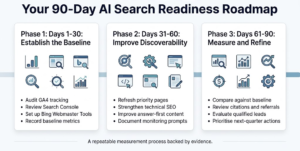
The best way to improve AI search measurement is to introduce it systematically rather than changing your entire SEO strategy at once.
This 90-day roadmap gives SEO professionals and business owners a practical sequence for building a reliable baseline, improving visibility, and connecting performance to commercial outcomes.
Days 1 to 30: Establish your measurement baseline
Begin by auditing your current analytics setup.
Confirm that GA4 is recording sessions, landing pages, and key events correctly. Review your Search Console property and verify that you can access the available generative AI performance reports.
Set up Bing Webmaster Tools and review the AI Performance report where available.
Document the AI referral sources you can identify, the conversions you measure, and the attribution limitations that affect your website.
Then record baseline performance for your selected reporting period. Include traditional organic clicks, AI impressions, citations, identifiable AI referral sessions, qualified leads, and sales where the relevant data exists.
Do not create artificial targets for metrics that you have not yet measured reliably.
Days 31 to 60: Improve content and discoverability
Use the baseline to identify your most important content opportunities.
Prioritise pages that support commercial goals, answer important customer questions, or demonstrate relevant expertise.
Improve their clarity, accuracy, internal linking, and conversion paths. Review technical issues that prevent important pages from being accessed or understood.
Create a manageable list of AI visibility monitoring questions and document how you test them.
At this stage, the objective is to establish a repeatable process rather than maximise the number of published articles.
Days 61 to 90: Evaluate results and refine the strategy
Compare your latest measurements with the baseline.
Identify which pages have gained visibility, which AI sources have produced measurable visits, and which landing pages have contributed to qualified enquiries.
Investigate unexpected changes before deciding what caused them.
If a content update coincides with improved citations, treat the relationship as a useful observation rather than proof that the update caused the improvement. Other changes may have contributed.
Use the findings to prioritise the next quarter’s technical work, content development, and conversion improvements.
By the end of 90 days, your team should have a more consistent reporting process and a clearer understanding of which AI search opportunities deserve further investment.
Common AI Traffic Measurement Mistakes to Avoid
Even experienced SEO teams can draw incorrect conclusions when they use unfamiliar metrics without documenting their limitations.
Watch out for these common mistakes.
- Treating citations as website visits. A cited page may receive no click, so keep visibility and referral sessions separate.
- Counting every direct session as AI traffic. Direct traffic has multiple possible causes, and it should not be relabelled without evidence.
- Reporting AI visibility without business context. More mentions may be useful, but qualified enquiries and sales are necessary to assess commercial value.
- Comparing incompatible metrics. An AI impression, a citation, a session, and a conversion measure different things.
- Drawing conclusions from small samples. Report counts alongside percentage changes and avoid treating short-term fluctuations as established trends.
- Overlooking traditional SEO. Technical accessibility, useful content, relevant links, search performance, and conversion optimisation remain important parts of a complete strategy.
- Publishing content solely to satisfy AI systems. Prioritise genuinely useful information, original expertise, and accurate explanations rather than repetitive pages designed around superficial keyword variations.
Avoiding these mistakes gives you a stronger basis for evaluating new AI search opportunities as measurement tools evolve.
The Role of DigiWizard in Your 2027 AI SEO Strategy
For businesses operating in Ireland, preparing for AI search should involve more than installing an analytics dashboard.
You need a strategy that connects technical SEO, content quality, local visibility, AI search optimisation, and measurable business outcomes.
DigiWizard offers SEO services for businesses looking to strengthen their search presence, while its Answer Engine Optimisation services are relevant to businesses exploring visibility across AI-powered answer experiences.
The right starting point depends on your existing website, target market, available data, and commercial objectives.
An established website with strong organic visibility may need more advanced AI measurement and content refinement. A smaller business with technical problems may benefit more from resolving indexing issues, improving its service pages, and establishing accurate conversion tracking first.
The priority should be a practical strategy based on your actual situation rather than a generic promise of AI rankings.
If you want to understand where your website currently stands, you can request a free consultation with DigiWizard to discuss your SEO priorities and the next steps for improving measurable search performance.
Frequently Asked Questions
How should SEOs measure AI traffic in 2027?
SEOs should combine identifiable AI referral sessions in GA4, generative AI impressions in Google Search Console, citation data in Bing Webmaster Tools, and business outcomes recorded in analytics or a CRM. Keep each metric separate and document what it measures.
Can Google Analytics 4 track ChatGPT traffic?
GA4 can track visits when ChatGPT or another AI service passes identifiable referral information and the analytics setup captures it. However, it cannot reliably identify every AI-influenced visit, especially when users return later through direct traffic or another channel.
How do I measure whether my website appears in AI search results?
Use the available generative AI performance reports in Google Search Console and AI Performance reporting in Bing Webmaster Tools. For other platforms, monitor identifiable citations and use a consistent set of relevant questions, recording the date, platform, brand mentions, and source URLs.
What is the difference between AI traffic and AI visibility?
AI traffic refers to measurable website visits attributed to AI-related sources. AI visibility refers to your website or brand appearing in AI-generated answers, whether or not someone clicks a link. A business can gain visibility without receiving a corresponding increase in referral sessions.
Which AI SEO metrics matter most for businesses?
The most useful metrics depend on the business model, but generally include AI citations, reported impressions, identifiable referral sessions, engagement, qualified leads, conversion rates, and attributable revenue. Businesses should prioritise metrics that help them understand customer acquisition rather than focusing exclusively on visibility.
Should businesses stop focusing on traditional SEO to prepare for AI search?
No. Traditional SEO remains an important foundation for discoverability. Businesses should continue improving technical accessibility, relevant content, internal linking, website usability, and conversion tracking while adding AI visibility and referral measurement to their reporting.
How long does it take to see results from AI SEO improvements?
There is no dependable universal timeline. Changes in crawling, indexing, citations, referral traffic, and lead generation can occur at different rates. Establish a baseline, document your changes, and review results over several reporting periods before attributing improvements to a specific action.
Prepare Your Website for AI Search in 2027
AI search measurement is most valuable when it helps you understand where your business is visible, which visitors are finding your website, and whether that discovery leads to genuine opportunities.
Start by establishing your measurement baseline, fixing gaps in your analytics, and identifying the pages that deserve the most attention.
If you need support connecting SEO, AI visibility, and lead generation, speak with DigiWizard about your website and search strategy. Build a measurement process you can trust, make decisions based on evidence, and enter 2027 with a clearer plan for sustainable organic growth.