Irish businesses are operating in a market where values drive decisions. According to PwC’s 2024 Voice of the Consumer Survey, 43% of Irish consumers are actively buying more sustainable products to reduce their environmental impact. For any Irish brand, that shift is no longer background noise. It is a commercial signal. This guide covers everything you need to know about sustainable marketing in Ireland: what it means, what strategies actually work, what grants are available, and how to do it without crossing into greenwashing territory.
What Is Sustainable Marketing and Why Does It Matter in Ireland?
Sustainable marketing is the practice of promoting products, services, and brand values in a way that reflects genuine environmental and social responsibility.
It goes beyond recycled packaging or a green logo. At its core, it means aligning your messaging, social media channels, and business behaviour with the values of today’s Irish consumer.
The Irish Market Context
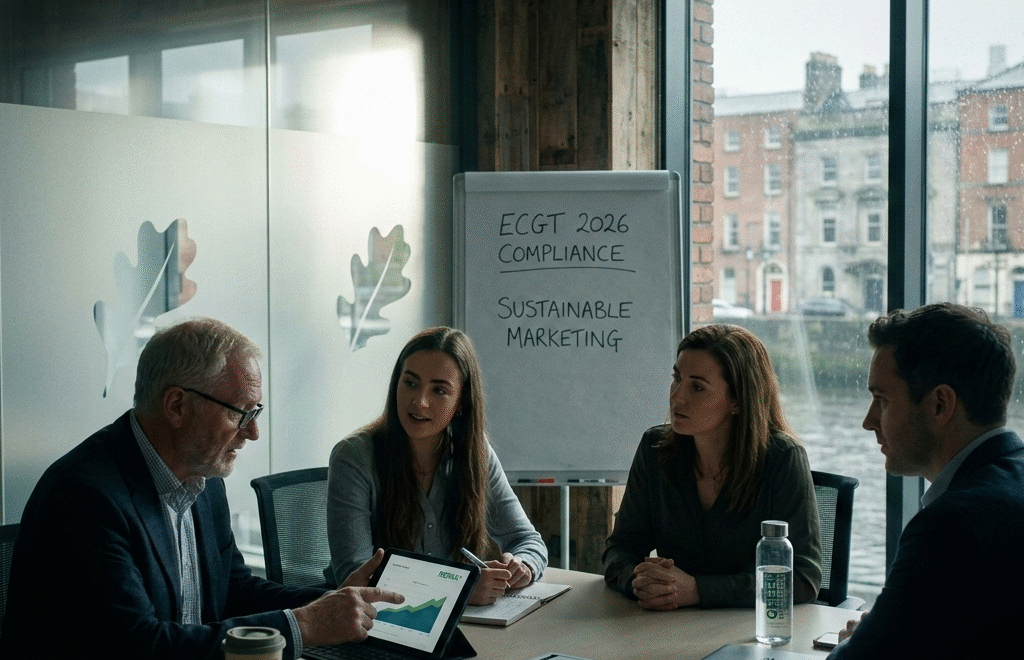
Ireland is not operating in a vacuum. The EU’s Empowering Consumers for the Green Transition Directive (ECGT), adopted in March 2024, will become legally enforceable from September 2026. It bans generic environmental claims like “eco-friendly,” “green,” or “climate neutral” unless they are fully substantiated.
In Ireland specifically, the Consumer Protection Act 2007 already prohibits misleading commercial practices, including inaccurate environmental claims.
This means sustainable marketing in Ireland is not just a good strategy. It is becoming a compliance requirement that starts with how your brand is presented, from your website to your paid and organic channels.
Why Irish Consumers Respond to It
The data is clear. PwC’s Irish Consumer Insights research found that 73% of Irish consumers are willing to pay above-average prices for products made from recycled, sustainable, or eco-friendly materials.
Meanwhile, 72% favour companies known for ethical practices. That is a significant commercial premium waiting for brands that build genuine green credibility and make it visible through strong local SEO and search presence.
Now that we understand what sustainable marketing means in an Irish context, let’s explore the strategies that deliver real results for Irish businesses.
Sustainable Marketing Strategies That Work for Irish Businesses
The most effective sustainable marketing strategies in Ireland share one quality: they are grounded in proof, not promises. Whether you are investing in Google Ads, organic search, or social content, the message must reflect real business behaviour.
Here is how Irish businesses can build and communicate a credible green position.
1. Lead With Authenticity, Not Just Messaging
Research from the Institute of Sustainability Studies confirms that brand authenticity is a core driver of purchasing decisions in sustainability contexts. Consumers are especially sceptical about green claims.
Authenticity means your sustainability story starts from the inside: actual operational changes, real certifications, and measurable targets.
2. Build a Transparent ESG Foundation
As Canopy Creative highlights in their ESG guide, an ESG policy is more than a compliance document. It is a communications asset.
Publishing clear ESG commitments on your website, supported by evidence, tells both customers and search engines that your sustainability position is serious and accountable.
3. Tell the Story, Not Just the Statistic
People connect with stories. Share the journey of your brand’s sustainability progress: the decisions you made, the changes you implemented, and the results you achieved.
This approach builds emotional connection, which research consistently shows drives brand loyalty more effectively than product claims alone.
4. Use Digital Channels Strategically
All-Ireland Sustainability notes that Irish businesses are increasingly using digital transformation tools like AI and data platforms to track and communicate environmental performance.
Your sustainable marketing strategy should include content marketing, social media, email campaigns, and a strong local SEO presence so that eco-conscious consumers in your area can find you at the exact moment they are looking.
5. Engage Your Audience, Not Just Your Customers
The Local Enterprise Office’s Green and Sustainability Marketing workshop emphasises that effective sustainable marketing encourages active participation. Think recycling programmes, sustainability challenges, and community initiatives that turn customers into advocates.
Running targeted Facebook Ads campaigns around your sustainability story is a proven way to reach value-driven Irish consumers and build that engaged community at scale.
6. Measure and Report What You Claim
Set specific KPIs for your sustainability marketing efforts. Track metrics like carbon footprint reduction, waste diverted, or energy saved, and report them publicly. This is what separates credible green marketing from greenwashing.
With a solid strategy in place, the next question for most Irish businesses is: where is the money to implement it?
Sustainable Marketing Ireland Grants and Funding Supports
One of the most practical and underused advantages for Irish businesses is the range of government-backed funding available to support sustainability initiatives.
Green for Business (Free Service)
Available through your Local Enterprise Office, the Green for Business programme provides a free consultancy service where an expert identifies environmental cost-saving opportunities and prepares a detailed report. This is available to small enterprises with 1 to 50 employees and a turnover above €30,000.
GreenStart (Up to 80% Funded)
GreenStart provides up to 7 days of consultancy support to help your business develop environmental management systems, reduce waste, measure your carbon footprint, and build a sustainability action plan. The LEO funds up to 80% of the cost.
Energy Efficiency Grant
According to the Local Enterprise Office, the Energy Efficiency Grant covers 75% of eligible costs, from a minimum of €750 to a maximum of €10,000, for businesses implementing energy-saving technologies following a Green for Business or SEAI audit.
SEAI Business Energy Grants
The Sustainable Energy Authority of Ireland continues to expand its business grant programme in 2026, with supports covering solar PV installation, business energy audits, and fleet electrification for Irish businesses of all sizes.
Enterprise Ireland GreenPlus
For Enterprise Ireland clients, the GreenPlus programme funds medium-scale sustainability projects at up to 50% of eligible costs, up to a maximum of €100,000.
| Grant / Programme | Who It’s For | Max Support |
| Green for Business | SMEs (1-50 employees) | Free service |
| GreenStart | Micro to small enterprises | Up to 80% funded |
| Energy Efficiency Grant | Small enterprises post-audit | Up to €10,000 |
| SEAI Solar PV Grant | All business sizes | Up to €162,600 |
| Enterprise Ireland GreenPlus | EI clients | Up to €100,000 |
These supports mean Irish businesses can invest in genuine sustainability without bearing the full cost upfront. This removes one of the most common barriers to adoption.
Now let’s look at how leading Irish brands are putting sustainable marketing into practice.
Sustainable Marketing Examples from Irish Businesses
Understanding what best practice looks like in Ireland helps set a realistic benchmark for your own strategy.
Sweet N Green Café, Clare
This Clare-based café embedded sustainability from day one. They accessed the Green for Business programme and an Energy Efficiency Grant through their Local Enterprise Office. Their marketing centres on locally sourced ingredients, minimal waste, and eco-conscious operations, all backed by real practice.
Repak: Circular Economy Leadership
Repak has become a recognised model for circular economy marketing in Ireland, helping businesses communicate their recycling and waste management credentials clearly and credibly to Irish consumers.
Kerry Group and Musgrave Group
Both companies have embedded sustainable sourcing and supply chain transparency into their brand communications. This is a best-practice example of how large Irish businesses use sustainability not just as a compliance story but as a trust-building marketing asset.
These examples share a common thread: the marketing reflects real operational commitment. That alignment is what Irish consumers and regulators are increasingly demanding.
Why Sustainable Marketing Is Important for Irish Businesses in 2026
Understanding the commercial case for sustainable marketing in Ireland goes beyond ethics. There are measurable business benefits.
It Builds Consumer Trust and Loyalty
EY’s 2026 Future Consumer Index confirms that in Ireland, trust drives loyalty. Brands that build credibility around sustainability are better positioned to retain customers even when competing on price becomes difficult.
It Attracts and Retains Talent
Employees, particularly Millennials and Gen Z, want to work for organisations whose values match their own. A clear, credible sustainability position helps Irish businesses recruit and retain the talent driving their growth.
It Protects Against Regulatory Risk
With the EU’s ECGT set to apply from September 2026, Irish businesses making vague environmental claims face real legal exposure. Building a sustainable marketing strategy now means compliance is built in, not bolted on.
It Opens Access to Funding
Many of the grants outlined above are specifically designed to reward businesses that take sustainability seriously. Credible sustainability marketing is increasingly a prerequisite for accessing public funding.
It Improves Long-Term Profitability
PwC’s consumer research found that one in two Irish consumers will pay up to 10% more for products produced sustainably or ethically. That pricing premium is a direct profitability benefit for brands that invest in genuine green credentials.
How to Avoid Greenwashing in Your Sustainable Marketing Strategy
Greenwashing, which means making environmental claims that are vague, misleading, or unsubstantiated, is the single biggest risk in sustainable marketing in Ireland today.
The European Commission’s own review found that over half of all green claims made by businesses were vague, misleading, or based on unfounded information.
What Greenwashing Looks Like in Practice
- Saying a product is “eco-friendly” without defining what that means.
- Claiming “carbon neutrality” based on offsets rather than actual emission reductions.
- Highlighting one green attribute while ignoring a product’s wider environmental impact.
- Using green imagery or language that creates a misleading impression of sustainability performance.
How to Market Sustainably Without Greenwashing
- Make only specific, provable claims.
- Link claims to certifications, audits, or third-party verification.
- Be transparent about where you are on your sustainability journey, because consumers respect honesty.
- Avoid absolute statements; use evidence-supported language like “we have reduced emissions by X%” instead of “we are green.”
The EU’s ECGT Directive, effective from September 2026, will formally ban generic claims like “climate neutral” based on carbon offsets. Irish businesses should audit their current marketing language now against these standards.
This also applies to paid advertising. If you are running Google Ads campaigns that include environmental claims, those ads must meet the same standard of substantiation as your organic content.
Sustainable Marketing Ireland Jobs: The Emerging Career Landscape
Sustainable marketing in Ireland is also creating a growing number of career opportunities for professionals who can navigate this space.
Roles in Demand
- Sustainability Communications Manager
- ESG Content Strategist
- Green Marketing Consultant
- Corporate Social Responsibility (CSR) Lead
- Purpose-Led Brand Manager
Where to Look
Irish sustainability roles are increasingly advertised through Enterprise Ireland partner networks, LinkedIn, and platforms like IrishJobs.ie. The Institute of Sustainability Studies also offers CPD-certified courses specifically in sustainable marketing and ESG communications, which is a strong credential for anyone building a career in this space.
The demand for professionals who can combine marketing expertise with environmental credibility is growing alongside regulatory pressure and consumer expectations. In 2026, this is one of Ireland’s fastest-growing career areas, and that trajectory is only set to continue.
Building Your Sustainable Marketing Strategy: A Step-by-Step Framework
Whether you are an SME or an established Irish brand, the path to effective, sustainable marketing follows a clear sequence.
Step 1: Audit Your Current Position. Understand your actual environmental impact across operations, supply chain, and product lifecycle before making any claims.
Step 2: Set Measurable Goals. Define specific, time-bound sustainability objectives. For example, “reduce packaging waste by 30% by the end of 2027.”
Step 3: Access Available Funding. Apply for the Green for Business programme through your Local Enterprise Office as a starting point. This provides expert guidance and unlocks further funding pathways.
Step 4: Build Your ESG Policy. Document your sustainability commitments in a clear policy. Publish it on your website and share it with stakeholders.
Step 5: Align Your Marketing. Ensure all marketing communications reflect your actual sustainability position, not aspirations. Train your team on what claims are and are not permissible under Irish and EU law.
Step 6: Tell Your Story Consistently Use your website, social media marketing, email marketing, and content strategy to share your sustainability journey in a way that educates, engages, and builds trust.
Step 7: Measure and Report Track your sustainability KPIs and publish annual updates. Transparency is your strongest credibility tool.
If you want expert support building and executing a sustainable digital marketing strategy that reflects your brand’s genuine green credentials, the team at Digiwizard specialises in helping Irish businesses communicate with clarity and authority. From SEO and local search visibility to social media, Google Ads, Facebook Ads, and web development, every channel plays a role in making your sustainability story land with the right audience.
Frequently Asked Questions About Sustainable Marketing in Ireland
What is sustainable marketing in Ireland? Sustainable marketing in Ireland refers to promoting products and services in a way that is environmentally responsible, socially ethical, and transparent, and that complies with Irish and EU regulations on environmental claims. It involves aligning your brand messaging with genuine operational sustainability practices.
What grants are available for sustainable marketing in Ireland? Irish businesses can access the Green for Business programme (free), GreenStart (up to 80% funded), the Energy Efficiency Grant (up to €10,000), and Enterprise Ireland’s GreenPlus programme (up to €100,000). All are accessed through Local Enterprise Offices or Enterprise Ireland.
Why is sustainable marketing important for Irish businesses? Sustainable marketing builds consumer trust, opens access to government funding, protects against regulatory risk, and increasingly delivers a direct commercial premium. According to PwC, one in two Irish consumers will pay up to 10% more for sustainably produced goods.
What are sustainable marketing examples in Ireland? Examples include Sweet N Green café in Clare, Repak’s circular economy messaging, Kerry Group’s sustainable sourcing communications, and Musgrave Group’s supply chain transparency initiatives.
What is greenwashing, and how do I avoid it? Greenwashing means making environmental claims that are vague, misleading, or unverified. To avoid it, only make claims you can substantiate with data, certifications, or third-party audits and ensure your marketing language complies with the EU’s ECGT Directive, effective September 2026.
Are there sustainable marketing jobs in Ireland? Yes. Roles such as sustainability communications manager, ESG content strategist, and purpose-led brand manager are growing in demand across Irish companies of all sizes. Platforms like LinkedIn and IrishJobs.ie regularly list these positions.
Sustainable marketing in Ireland is no longer an optional extra. It is the standard that Irish consumers, regulators, and investors are beginning to require. The businesses that build this capability now will hold a competitive advantage that is very difficult for late movers to close. Start with your own story, back it with evidence, and let your marketing grow from there.