
Search engines rank websites by crawling the web, indexing content, and using complex algorithms to analyze hundreds of factors. Search engines like Google use web crawlers to discover, index, and rank web pages based on relevance and quality. Ranking is done programmatically, and Google doesn’t accept payment to rank pages higher. Search engines ensure the most relevant, high-quality, and trustworthy results appear first in search results.
Key factors search engines use to rank websites include user intent, content relevance, backlink authority, page speed, mobile-friendliness, and user experience. Complex algorithms analyze these factors to determine relevance and quality, ensuring search results match user intent and deliver trustworthy results.
What Are the 4 Pillars of SEO?
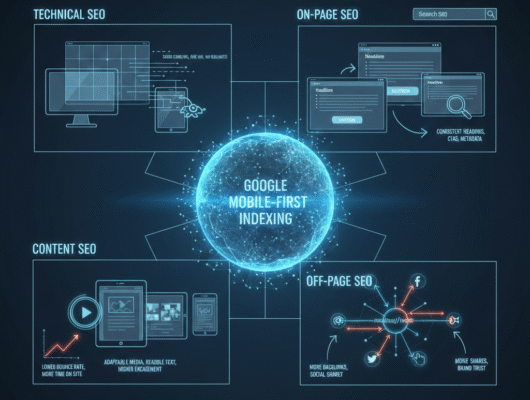
The 4 Pillars of SEO are Technical SEO, On-Page SEO, Content, and Off-Page Authority. These pillars form the foundation for improving website visibility, driving traffic, building authority, and facilitating higher rankings in search engines like Google through crawlable, relevant, well-structured, and reputable websites.
Technical SEO
Technical SEO ensures a website is crawlable and well-structured for search engines. It helps search engines crawl, index, and rank pages based on relevance and quality. Technical SEO strengthens site structure, page speed, and mobile-friendliness. When a website is technically sound, it supports visibility and facilitates higher rankings.
On-Page SEO
On-Page SEO optimizes website elements for relevance and user intent. It aligns content, structure, and keywords with search intent. On-Page SEO improves content relevance and user experience. When pages are clear and structured, search engines understand quality and rank websites higher.
Content
Content builds relevance and drives traffic. Strong content matches user intent, delivers high-quality information, and improves visibility. Content supports rankings when it is trustworthy and structured. Businesses invest in content because content fuels growth and strengthens authority.
Off-Page Authority
Off-Page Authority builds reputation through backlinks and external signals. Backlinks strengthen authority and trustworthiness. Off-Page Authority increases credibility and supports higher rankings. When authority grows, visibility grows.
How Does a Search Engine Index a Website?
A search engine indexes a website by using automated software, called crawlers or spiders, to discover, analyze, and store pages in a massive database. Google processes and analyzes content, then stores information in an inverted index for rapid retrieval.
Search engines use crawlers to discover pages by following links from known pages to new ones. These bots analyze content such as text, images, and video. They evaluate relevance, quality, and structure. This analysis helps the search engine understand what the page is about.
Why Is the Search Engine Crawling Process Essential for Visibility?
The search engine crawling process is essential for visibility because it is the critical, initial step of content discovery. Without crawling, web pages cannot be indexed or ranked by search engines like Google, which prevents visibility in search results.
The search engine crawling process acts as a systematic scanning and discovery of new or updated content via links. Crawlers analyze content and ensure a site is added to search engine databases through indexing. If pages are not discovered, they are not indexed. If they are not indexed, they are not ranked.
Crawling in SEO directly affects whether your website gets indexed and ranked. Indexing organizes information before a search. Ranking determines which pages appear first. When crawling works, indexing follows, and ranking becomes possible. When crawling fails, visibility disappears.
Which Algorithms Determine Website Ranking Positions?
Website ranking positions are determined by a complex, constantly evolving set of algorithms and systems designed by Google. These algorithms analyze hundreds of ranking signals to rank content based on relevance, quality, usability, and context.
Google Algorithms and Systems
Google utilizes a combination of systems, not one single formula. These systems determine website ranking positions by analyzing ranking signals. Ranking signals measure relevance, quality, usability, and context. The algorithms process content programmatically and decide which pages rank higher in search engine results.
Ranking Signals
Ranking signals are factors that algorithms analyze to determine ranking positions. These signals include relevance to user intent, content quality, usability, and contextual meaning. The systems evaluate how well a page matches a query. Strong signals improve ranking positions because the algorithms detect higher relevance and quality.
PageRank (PR)
PageRank is an algorithm used by Google Search to rank web pages in search engine results. PageRank evaluates links as signals of authority and importance. It measures how pages connect through links and assigns value based on link structure. This system strengthens ranking positions when authority signals are strong.
Google algorithms determine ranking positions by combining systems, signals, and PageRank into one evolving framework. When relevance, quality, usability, and context align, ranking improves. Focus on signals that matter, and let the algorithms work in your favor.
How Do On-Page Factors Influence Search Engine Evaluations?
On-page factors influence search engine evaluations by allowing algorithms to determine a page’s relevance, quality, and user experience, which directly impacts search engine results pages (SERP) rankings. Search engines like Google use key factors to understand, index, and rank content.
On-page factors directly influence evaluations because algorithms analyze high-quality content matching user intent, optimized titles, header tags, mobile responsiveness, and fast loading speeds. These elements determine relevance, quality, and user experience. Meaning, relevance, and quality are used to determine how websites rank on Google. Factors such as mobile-friendliness, page speed, and non-intrusive design contribute to rankings, especially as tiebreakers in competitive queries.
Why Does Backlink Authority Impact How Search Engines Rank Websites?
Backlink authority impacts how search engines rank websites because it serves as a crucial trust signal. Search engines like Google treat backlinks as ranking factors and “votes of confidence” that indicate credibility, relevance, value, and higher visibility in search results.
Backlink authority acts as a digital endorsement. When a high-authority, quality link points to a website, it passes link equity. Link equity boosts domain authority. Domain authority signals to search engines that the content deserves higher visibility. Strong authority influences how search engines rank websites.
How Technical Optimization Affects Search Engine Performance
Technical optimization affects search engine performance by enabling search engines like Google to efficiently crawl, index, and understand a website, resulting in higher rankings, faster load times, improved user experience, and stronger visibility through structured data and secure HTTPS connections.
Technical optimization boosts performance because it removes barriers. It improves site architecture, mobile responsiveness, secure connections (HTTPS), and structured data. These elements help search engines crawl and index pages quickly and correctly. When crawling and indexing improve, rankings improve.
Poor technical SEO hurts performance. If technical SEO is poor, search engines struggle to discover, crawl, and index your site. Slow load times and weak mobile responsiveness reduce user experience. Weak structure confuses understanding. Confusion limits visibility.
How Do Site Architecture and Speed Improve Indexing Efficiency?
Site architecture and speed improve indexing efficiency by enabling search engine crawlers to discover, crawl, and index pages faster and more thoroughly. Search engines like Google use crawl budget, logical structure, and high speed to ensure important content is indexed quickly and accurately.
Site Architecture
Site architecture improves indexing efficiency because a flat, logical structure reduces clicks to content. Fewer clicks help crawlers discover pages faster. Clear structure supports thorough crawling. Effective management of faceted navigation prevents duplicate content problems. When duplicate content problems decrease, crawling efficiency increases. Efficient crawling leads to more accurate indexing.
Site Speed
Speed improves indexing efficiency because high speed allows bots to crawl more pages within their allotted crawl budget. Faster load times reduce delays. Reduced delays allow deeper crawling. Deeper crawling increases the number of indexed pages. When bots crawl more pages quickly, important content is indexed faster and more accurately.
Indexing Efficiency and Query Performance
Indexing improves query performance by reducing the amount of data scanned during searches. Organized data supports rapid retrieval. Rapid retrieval supports efficient search results. Efficient indexing strengthens overall search engine performance.
Should You Use Structured Data to Influence Search Results?
Yes, you should use structured data to influence search results. Google states structured data is not a direct ranking factor, but it enables rich results that improve visibility, click-through rates (CTR), and user engagement on the search results page (SERP).
Structured data influences how your site appears in search results because it enables rich results. Rich results are visually enhanced search features such as star ratings, recipe details, product prices, and event dates. These features often appear at the top of the SERP. Enhanced appearance increases visibility and encourages interaction.
Does Mobile-First Indexing Change How Search Engines Rank Websites?
Yes, mobile-first indexing changes how search engines rank websites. Google prioritizes the mobile version of content for indexing and ranking, making search visibility directly tied to mobile performance, loading speed, and content parityWhat Are the 3 C’s of SEO?
The 3 C’s of SEO are Content, Code, and Credibility. These pillars ensure a website provides value, is accessible to search engines like Google, and earns trust, forming the backbone of every successful SEO strategy.
Content
Content is the heart of SEO. High-quality, relevant, and engaging content aligns with user intent and helps search engines evaluate relevance, quality, and authority. Well-structured content improves indexing, ranking, and visibility in search engine results pages (SERPs).
Code
Code refers to the technical foundation of a website. Clean, efficient, and crawlable code enables search engines to efficiently crawl, index, and understand pages. Technical optimization, site architecture, mobile responsiveness, and structured data are all part of code that supports SEO performance.
Credibility
Credibility is built through trust signals such as backlinks, authority, and reputation. Search engines use credibility to assess whether a website is reliable, relevant, and valuable. Strong credibility boosts rankings, visibility, and user confidence. Connections, context, and authority all reinforce this pillar.
What Are the 4 Types of Keywords?
The 4 types of keywords are informational, navigational, commercial, and transactional, each serving distinct search intent, user behavior, and content strategy purposes. Informational seeks knowledge, navigational targets a specific site, commercial researches products, and transactional drives purchases.
Informational keywords focus on users looking for knowledge, tips, or how-to guidance. For example, someone searching “how to clean gutters” wants to learn, not buy. These keywords help content creators educate their audience, build authority, and increase organic traffic through blog posts or tutorials.
Navigational keywords are used when users want a specific website or brand. Searching “Nike official store” is navigational because the intent is clear: reach a known destination. SEOs leverage these by optimizing brand presence, site links, and landing pages to capture visitors already aware of a brand.
How Accurate Is Google Search?
Google Search is highly efficient at finding and ranking information, with around 85% of common queries returning accurate results. It prioritizes authoritative sources, but accuracy depends on content reliability, user verification, and limitations in AI-generated or poorly ranked pages.
Google Search’s efficiency comes from its ability to crawl billions of web pages, index content, and rank results using algorithms like PageRank and AI enhancements. For everyday queries, it quickly provides relevant answers, making it highly reliable for general knowledge, directions, and popular questions.
Content accuracy, however, is not guaranteed. Even high-ranking pages may include outdated, biased, or incorrect information. Google emphasizes authority signals—like backlinks, domain trust, and expertise—but cannot independently verify every claim on every page. Users still need critical thinking to assess reliability.
Do Google Sites Rank Better?
Google Sites do not rank better simply because they are owned by Google. Their search performance depends entirely on content quality, relevance, SEO optimization, and user engagement, with no inherent algorithmic preference in Google Search rankings.
Ranking factors for Google Sites are identical to those of other platforms. Factors like keyword relevance, site structure, mobile-friendliness, backlinks, and page speed determine visibility. Using Google Sites does not automatically boost SEO; strong content and optimization are what drive higher positions.
Content quality remains crucial. Even if a website is on Google Sites, poorly written, thin, or irrelevant content will perform worse than a well-optimized WordPress, Wix, or Squarespace site. Google’s algorithms focus on value to users, not ownership of the hosting platform.
What Do Gen Z Use Instead of Google?
Gen Z uses TikTok, Instagram, YouTube, Reddit, and AI tools like ChatGPT and Perplexity instead of Google, favoring authentic, video-based, user-generated, and AI-driven content for lifestyle, local, and product searches over traditional search results.
TikTok has become a key search tool for Gen Z because it delivers short, engaging videos that show products, trends, and life hacks quickly. Users often type hashtags or queries and scroll through recommendations, preferring visual discovery over reading long articles.
Instagram functions as both a social platform and a search engine. Through reels, guides, and hashtags, Gen Z finds fashion, food, local spots, and lifestyle inspiration. Visual storytelling and influencer content make Instagram a go-to alternative for discovery and trend research.
What Are the 5 C’s of Marketing Strategy?
The 5 C’s of marketing strategy are Company, Customers, Competitors, Collaborators, and Climate, forming a situational analysis framework that evaluates internal strengths, customer needs, competitor positioning, partnership opportunities, and external market or environmental factors.
The company focuses on evaluating internal strengths, weaknesses, capabilities, and resources. Businesses assess their brand, products, operational capacity, and financial health to determine what they can realistically deliver and where improvements are needed for strategic advantage.