Since 2 August 2026, Article 50 of the EU AI Act requires businesses to be open about certain uses of AI. For a typical Irish small business, three parts matter most: tell people when they’re chatting with an AI rather than a person, label deepfake images, audio or video, and label AI-written text published to inform the public on matters of public interest unless a human has properly reviewed it and taken editorial responsibility. Ordinary marketing written with AI help and checked by your team is usually lower risk, but the details depend on how you use it. This article is a practical overview, not legal advice. If AI is a big part of your content or customer service, speak to a solicitor. For the marketing side, our content and AEO team can help you set up a review process.
A Limerick estate agent asked us in September whether they now had to put “written by AI” on every property listing. They’d been using ChatGPT to draft descriptions, then editing them. The short answer was no, not for that use. But their website chatbot, which introduced itself as “Sarah from the lettings team”, was a different story.
What Article 50 covers
According to the practical guide published by artificialintelligenceact.eu, Article 50 sets out transparency duties in four situations. They apply to any AI system used in these ways, not only high-risk systems.
| Situation | Who’s mainly responsible | What it means in practice |
|---|---|---|
| AI that interacts directly with people, such as chatbots | Providers, with deployers involved in how it’s presented | People should know they’re talking to an AI, unless it’s obvious |
| AI that generates synthetic content | Providers of the AI tools | Outputs marked in a machine-readable way so they can be detected |
| Emotion recognition or biometric categorisation | Deployers | People affected must be informed |
| Deepfakes and AI text on matters of public interest | Deployers, meaning the business publishing it | Disclose that the content is AI-generated or manipulated |
Most Irish businesses are deployers, not providers. You’re using tools built by OpenAI, Google, Microsoft or others. The tool makers handle the technical marking. Your job is mostly about how you present AI to the public.
What it means for your marketing
Website chatbots
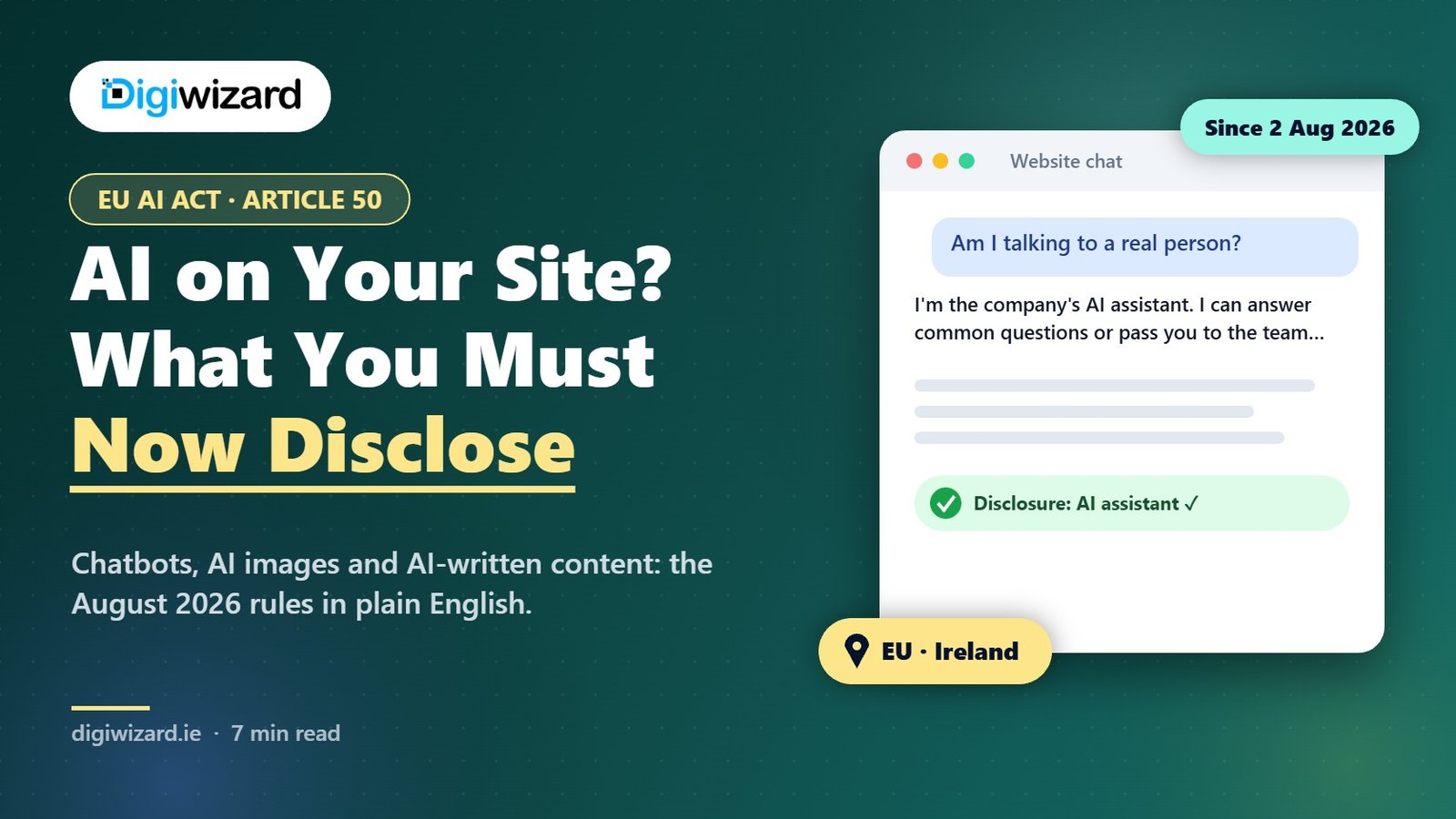
If your website or WhatsApp has an AI assistant, make it clear it’s an AI. A line like “I’m Digiwizard’s AI assistant. I can answer common questions or pass you to the team” does the job. Avoid giving the bot a human name and personality that suggests it’s a member of staff.
AI images, video and voice
If you publish AI-generated or AI-altered images, video or audio that show real-looking people, places or events, and someone could take them as genuine, label them. That includes a realistic AI “customer testimonial” video or a doctored photo of your premises. Clearly artistic or obviously fictional content has lighter requirements, but you still shouldn’t hide that AI was used. Frankly, fake testimonials are a bad idea under consumer law anyway.
Blog posts and articles
The labelling duty for text applies to AI-generated text published to inform the public on matters of public interest. Legal commentators note there’s an exemption where the text has been through human review or editorial control and someone holds editorial responsibility for it. For a business blog, the safest practice is simple: a named person reviews and edits every post before it goes live, and you keep a note of who approved it.
Product descriptions and ads
Routine commercial copy that a person reviews is generally not what Article 50(4) targets. But existing Irish and EU consumer protection law still applies. AI-written claims must be true, and you’re responsible for them.
Key dates
- 2 August 2026: Article 50 transparency obligations apply, as Cooley’s briefing explains.
- 2 December 2026: the deadline for providers of AI systems that were already on the market to meet the machine-readable marking duty, according to Kingsley Napley. This is mainly for the tool makers, not businesses using them.
National authorities supervise and enforce these rules. Breaches of Article 50 fall within the AI Act’s penalty framework, so it’s worth taking seriously even though enforcement is still bedding in.
Need AI-ready content that stays compliant?
We create and label content so it ranks in Google, gets cited by AI assistants and meets EU AI Act transparency rules. See how our AEO services works, or browse our client case studies.
A simple checklist for Irish businesses
- List every place you use AI with customers: chatbots, emails, images, videos, voice, blog content.
- Add a clear AI disclosure to any chatbot or automated messaging.
- Label realistic AI-generated or altered images, video and audio.
- Put a named human reviewer on every published article and keep a simple sign-off record.
- Check AI-written claims for accuracy before they go live.
- Update your privacy notice if AI tools process customer data.
- Ask your solicitor about anything unusual, such as emotion analysis or voice cloning.
Does labelling AI content hurt SEO?
There’s no evidence that a short, honest disclosure hurts rankings. Google has said for years that it judges content on quality and usefulness, not how it was produced, and its guide to generative AI features puts the emphasis on unique, people-first content. What does hurt is mass-producing thin pages with AI. Human review, which also helps with Article 50, is exactly what keeps content useful.
Questions About the EU AI Act and AI Content
Do I have to label blog posts written with ChatGPT?
Not in every case. The labelling duty targets AI-generated text published to inform the public on matters of public interest, and there’s an exemption where a human has reviewed it and holds editorial responsibility. Having a named person edit and approve each post is the practical safeguard. Check with a solicitor if you publish news or public-interest content.
Does my website chatbot need to say it’s AI?
Yes, people should be told they’re interacting with an AI system unless it’s obvious from the context. A clear opening line is the easiest way to do this.
When did the EU AI Act transparency rules start?
Article 50 obligations applied from 2 August 2026, with a later deadline of 2 December 2026 for some technical marking duties on existing AI tools.
Does this apply to small businesses in Ireland?
Yes. Article 50 isn’t limited to large companies or high-risk AI. If you use AI in one of the covered ways, the relevant duties apply.
Is this legal advice?
No. It’s a practical summary for marketers. For decisions about your specific situation, speak to a solicitor who works in data protection or technology law.
Set up a human review process
If your team uses AI to draft content, a simple review and sign-off process keeps it accurate, helps with Article 50 and makes the content better for search. Book a free consultation and we’ll help you set one up.