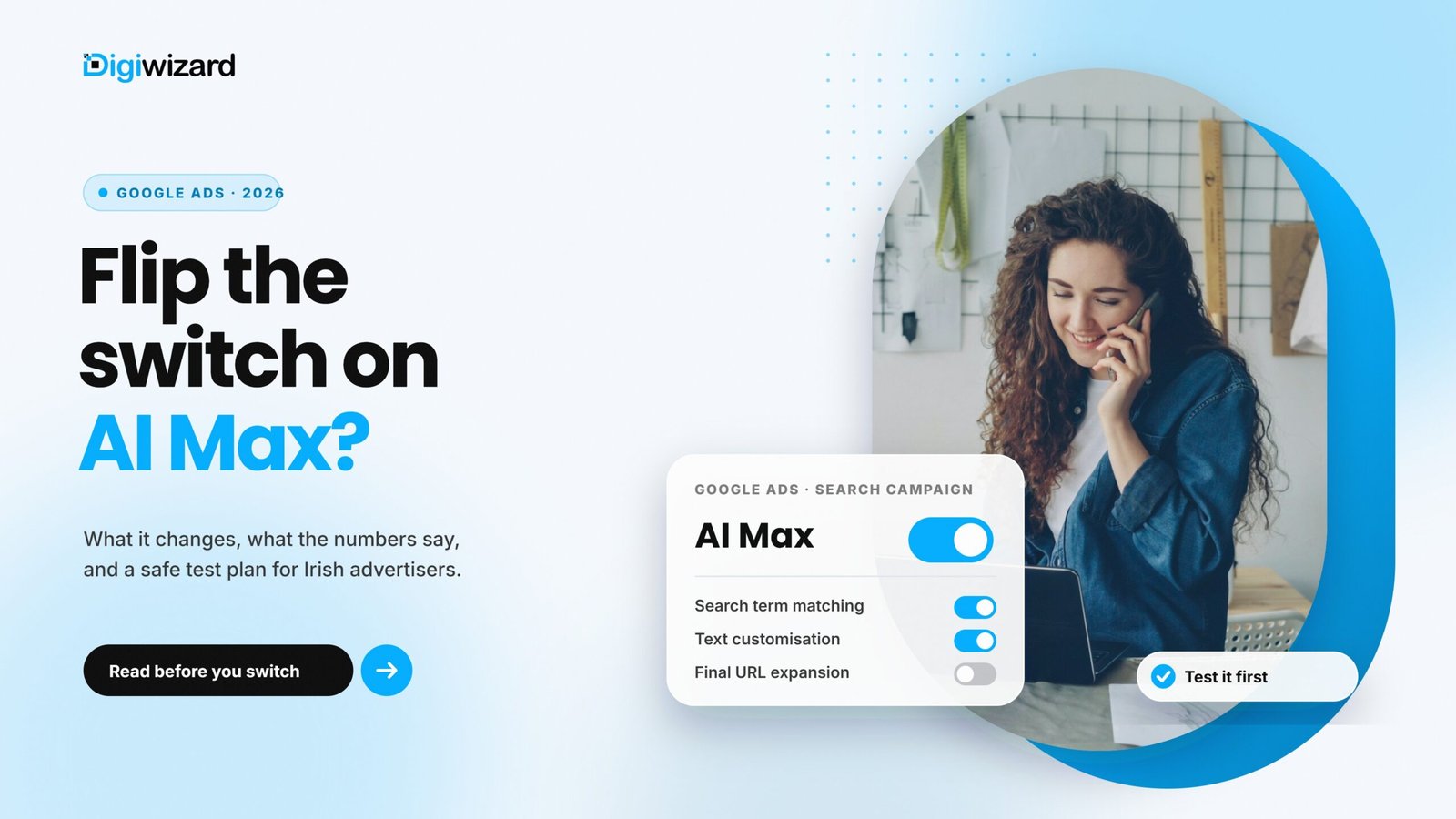
Google Ads AI Max is a one-click setting inside a normal Search campaign that lets Google match your ads to searches beyond your keyword list, rewrite your headlines and descriptions, and send clicks to whichever page on your site it thinks fits best. It left beta on 15 April 2026, and Google has been moving older campaign types onto it since. For an Irish small business, the honest answer is: test it on one campaign with clear limits, don’t switch it on across the account, and judge it on enquiries rather than clicks.
If you’ve had an email from Google about your broad match or Dynamic Search Ads campaigns this year, this is why.
What Google Ads AI Max actually changes
AI Max bundles three features. PPC Land’s running timeline and Google’s own help page describe them like this:
| Feature | What it does | What to watch |
|---|---|---|
| Search term matching | Shows your ads on searches outside your keywords, using broad match and “keywordless” matching | Irrelevant searches eating budget |
| Text customisation | Writes headlines and descriptions from your site and ads | Claims you can’t back up, wrong prices or areas |
| Final URL expansion | Sends clicks to a different page on your site | Visitors landing on blog posts instead of service pages; pinned headlines stop being respected |
What has already been switched over
- 15 April 2026: Google announced the retirement of Dynamic Search Ads, automatically created assets and the campaign-level broad match setting.
- September 2026: campaigns using campaign-level broad match or automatically created assets were converted to AI Max.
- February 2027: remaining Dynamic Search Ads campaigns are due to move to Performance Max or AI-powered Search campaigns. Google pushed this back from September 2026.
So if one of your campaigns used broad match at campaign level, it may already be running AI Max. Check the campaign settings before you assume it isn’t.
Not sure what Google changed in your account?
We audit Google Ads accounts for Irish businesses and show you which searches you are paying for and which ones bring in work. See how our Google Ads management in Ireland works.
Does it work? What the numbers say
Google says advertisers who switch on AI Max in Search campaigns typically see 14% more conversions or conversion value at a similar cost per conversion, based on its own 2025 data for non-retail advertisers. It reported a smaller 7% figure in April 2026, comparing the full suite with search term matching alone.
Independent figures are less rosy. Agency Monks found that 99% of AI Max impressions it analysed had no conversions, and Smarter Ecommerce reported roughly 35% lower return on ad spend across more than 250 retail campaigns. None of these are controlled studies, but together they say the same thing: results depend heavily on the account.
Small Irish accounts have one extra problem. Smart Bidding is required, and automated bidding learns from conversion data. A trades business getting eight calls a month gives the system very little to learn from.
How to test AI Max safely
1. Fix conversion tracking first
Track calls from ads, form submissions and bookings as separate conversions. If AI Max optimises towards page views or button clicks, it will find cheap clicks that never become customers.
2. Use a campaign experiment
Run AI Max against your current set-up on a 50/50 split, on your best-performing service only, for at least four weeks.
3. Set URL inclusions and exclusions
Limit landing pages to your service and product pages. Exclude your blog, careers page and anything else that doesn’t sell.
4. Add brand controls
Brand inclusions and exclusions stop AI Max matching you to competitor names you don’t want, or to your own brand searches you’d get anyway.
5. Write text guidelines
Google allows up to 25 term exclusions and 40 messaging restrictions per campaign. Use them to block words like “cheapest”, “24/7” or areas you don’t cover.
6. Read the search terms every week
AI Max reporting starts here: it appears as its own match type in the search terms report. Add negatives for anything irrelevant, and note which new searches actually converted.
7. Consider “locations of interest”
This AI Max-only setting targets people searching about a place, not people located there. It suits businesses whose customers plan from elsewhere: holiday lets in Kerry, wedding venues in Wicklow, or tours in Galway.
When to leave it off
- You get fewer than about 15 tracked conversions a month in the campaign
- Your service area is tight and wrong-area leads waste your time
- You’re in a regulated sector where ad wording has to be checked, such as finance, health or legal services
- Your site has few strong landing pages for Google to choose from
In those cases, exact and phrase match with good negatives and solid local SEO alongside will usually do more for you.
Questions about Google Ads AI Max
How do I enable AI Max in Google Ads?
Open the Search campaign, go to its settings and turn on AI Max for Search campaigns. You can then choose which features to keep on, and set brand, URL and text controls. Smart Bidding must be in place. Better still, test it as a campaign experiment first.
Is AI Max free?
There’s no extra fee. You pay for clicks as normal, but AI Max can show your ads on more searches, which can raise spend.
Can I turn AI Max off?
Yes, at campaign level. Search term matching can also be switched off per ad group. If Google converted a campaign for you, check its settings to see which AI Max features are on.
AI Max vs Performance Max: what’s the difference?
No. AI Max works inside a Search campaign and only on Google Search. Performance Max runs across Search, YouTube, Display, Gmail, Maps and Discover from one campaign.
Will AI Max show my ads in AI Overviews and AI Mode?
Google positions AI Max as its way to reach the longer, more conversational searches people now type. Whether your ads appear in AI features depends on Google’s ad eligibility rules for your market, so check the placement reports.
Get a second opinion before you switch it on
Send us read-only access to your account and we’ll show you what AI Max would change, campaign by campaign. Or book a free consultation to talk it through.