AI SEO in Dublin (people also call it LLM SEO) means making your business easy for ChatGPT, Gemini, Claude and Google AI Mode to find, understand and recommend when someone asks for a service you offer. Start by asking those tools the questions your customers ask, record which businesses they name and which pages they cite, then fix the gaps on your own site and listings. A generative engine optimisation review can help you work out which gaps cost you the most enquiries.
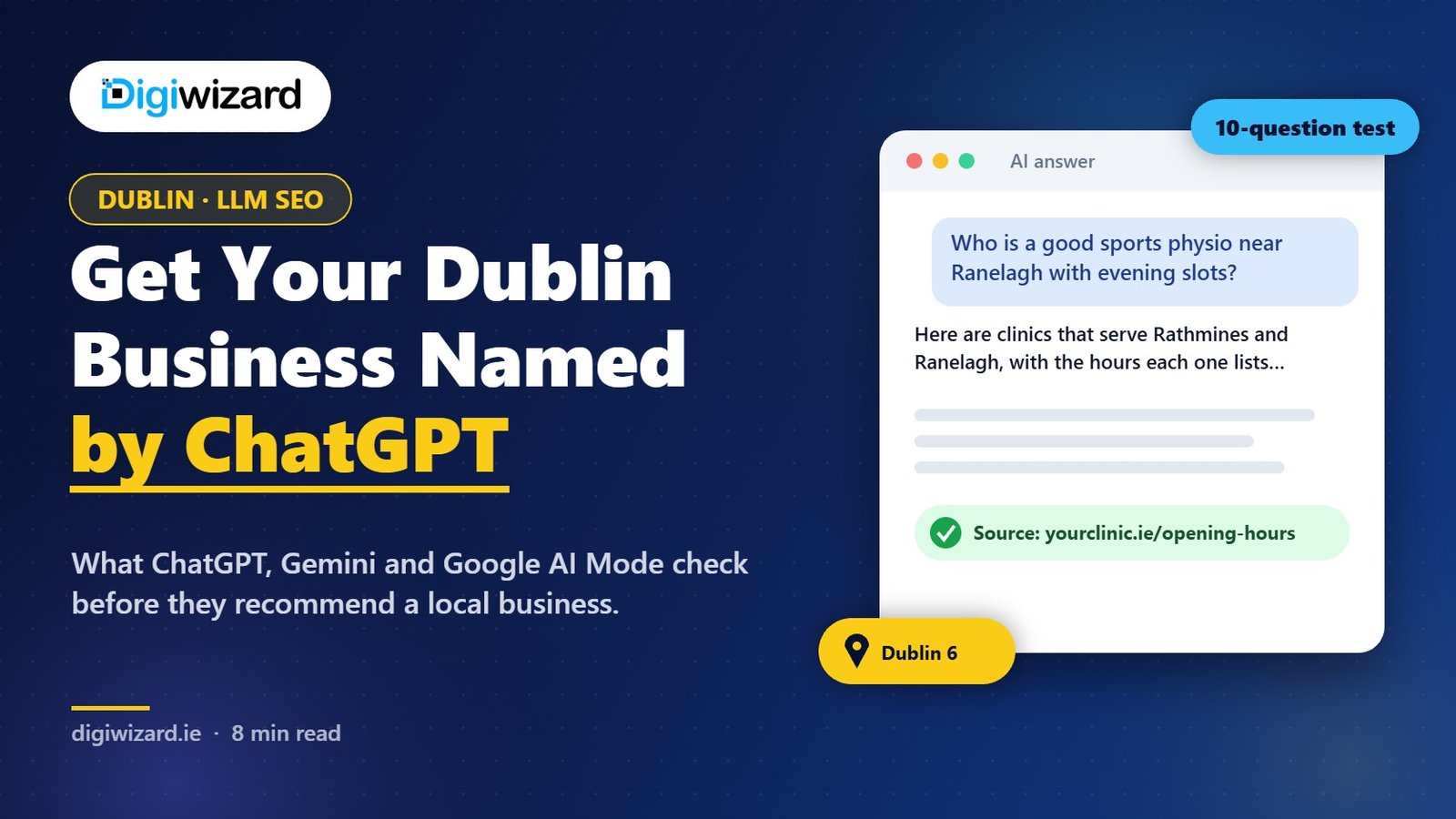
Picture a physiotherapy clinic in Rathmines. A new patient asks ChatGPT for a sports physio near Ranelagh who takes evening appointments. The answer names two clinics. One closed last year and the other is in Sandyford. The Rathmines clinic does evening sessions, but its website only says “flexible hours” and its opening times live in a PDF. Nothing about that clinic is wrong. It simply hasn’t said the things the model needed in a form it could use.
What LLM SEO means for a Dublin business
A large language model (LLM) writes an answer. When the answer needs current facts, such as which firms serve Dublin 6, AI search tools look things up on the web and summarise what they find. Your job is to make sure that what they find is accurate, specific and easy to quote.
That matters more each year. In its 2025 survey, the Central Statistics Office found that 42% of Irish internet users had used a generative AI tool in the previous three months. Google also rolled out AI Mode in Ireland in October 2025, so a conversational answer can now appear inside Google itself.
So, is LLM SEO a thing? Yes, but it isn’t a separate trade with secret rules. Google’s own guide to generative AI features says that optimising for them is still SEO, built on its core ranking and quality systems. What changes is what you check and how you measure it.
| Assistant | Where its local answers tend to come from | What to check first |
|---|---|---|
| Google AI Overviews and AI Mode | Google’s index, Google Business Profile and the pages that rank for related searches | Indexed service pages, a complete Business Profile, and the Generative AI report in Search Console |
| Gemini | Google’s index and Maps data | The same Business Profile details, reviews and category |
| ChatGPT Search | Web results it retrieves, plus the pages and listings it cites | Whether OAI-SearchBot can reach your pages and whether directories describe you correctly |
| Microsoft Copilot | Bing’s index | Bing Places and the AI Performance report in Bing Webmaster Tools |
| Claude and Perplexity | Web search results they retrieve for the question | Clear, crawlable pages and consistent third-party listings |
Treat the middle column as a working guide rather than a fixed rule. Each tool changes how it retrieves sources, and the same question can produce different answers on different days.
Run a Dublin prompt test before you change anything
Write six to ten questions in the words a customer would use before they knew your name. Put the area in the question, because Dublin is too broad for most local services. A client in Clontarf rarely wants a provider in Tallaght.
Unbranded questions
- Which electricians in Dublin 15 can install an EV charger this month?
- What is a good family dentist in Drumcondra that takes new patients?
- Which accountants in Dublin 2 work with tech start-ups?
- Who does commercial cleaning for offices in Sandyford?
Branded questions
- What services does [business name] offer in Dublin?
- Where is [business name] based, and which areas does it cover?
- What do customers say about [business name]?
Run each question in ChatGPT Search, Gemini, Google AI Mode and Copilot. Save the answer, the date and every link shown. Our ChatGPT visibility audit guide explains how to log mentions, accuracy and sources separately so you can trace each error back to the page that caused it.
Fix the pages AI tools quote
Once you know which questions you’re missing, look at the page that should answer each one. AI answers tend to lift short, specific statements. A page that says “we serve all of Dublin” gives a model little to work with. A page that says “we install EV chargers across Dublin 15, including Blanchardstown, Castleknock and Clonsilla, usually within ten working days” gives it a fact it can repeat and a customer can check.
Put the answer first
Open each service page with two or three sentences that say what you do, where, and for whom. Then add the detail people need before they enquire: prices or price ranges where you can share them, lead times, accreditation, and what happens after they get in touch.
Keep facts in text, not in images or PDFs
Opening hours, service areas and price lists often sit in banners or downloads. Put them in plain HTML on the relevant page as well. Google’s guide notes that important content should be available in text, and the same applies to any crawler that reads your page.
Show who is behind the work
Name the people who do the work and give their qualifications. A Dublin solicitor’s page that names the partner, the Law Society registration and the practice areas is easier to trust and to cite than one that says “our experienced team”.
Make your business details agree everywhere
AI tools compare what different sources say about you. If your website, Google Business Profile, Bing Places, Apple Business Connect and Golden Pages listing each show a different address or phone number, a model may skip you or repeat the wrong one.
| Detail | Where it should match |
|---|---|
| Trading name | Website header and footer, Business Profile, Bing Places, directories, social profiles |
| Address or service area | Contact page, service pages, Business Profile service areas, Bing Places |
| Phone and website link | Every listing you control, plus your email signature |
| Services offered | Service pages, Business Profile services and categories, trade association listings |
For businesses with more than one branch, our guide to local SEO for multi-location Dublin businesses covers how to keep each branch’s details distinct.
Is ChatGPT recommending your competitors instead of you?
We check how ChatGPT, Gemini, Copilot and Google AI Mode describe your business, then hand you a prioritised fix list you can act on straight away. See how our AI search optimisation (GEO) works, or browse our client case studies.
Earn mentions on sites AI tools already trust
Your own website is only one source. When Ahrefs studied 75,000 brands, it found that mentions of a brand across the web and on YouTube correlated more strongly with visibility in ChatGPT, AI Mode and AI Overviews than backlinks did. Correlation isn’t proof of cause, but it points in a sensible direction.
For a Dublin business, useful mentions might come from a local business association, a Dublin Chamber member listing, a feature in a neighbourhood news site, a supplier’s case study, or a short explainer video on YouTube that names your business and area. Google’s guide is clear that manufactured or fake mentions don’t help, so aim for coverage that a real customer would find useful.
Check crawler access and indexing
None of this works if the tools can’t reach your pages. Ask your developer to confirm three things:
- Your important pages are indexed in Google and eligible to show a snippet. Google lists this as the technical requirement for its AI features.
- Your robots.txt and firewall don’t block the search crawlers you want, such as Googlebot, Bingbot and OpenAI’s OAI-SearchBot.
- Your key facts load without a login, a cookie wall or a postcode search.
Our technical SEO service covers these checks if you don’t have a developer to hand.
Measure mentions, citations and enquiries separately
A mention, a citation and an enquiry are three different events. Keep them in separate columns.
| Signal | Where to find it |
|---|---|
| Mentions in answers | Your monthly prompt test log |
| Impressions in AI Overviews and AI Mode | The Generative AI report in Google Search Console |
| Citations in Copilot | The AI Performance report in Bing Webmaster Tools |
| Visits from AI tools | Referral traffic in your analytics, for example from chatgpt.com |
| Enquiries | Calls and form submissions, with a “how did you hear about us?” field |
See our guide to measuring AI traffic for how to set up the analytics side.
Questions About LLM SEO in Dublin
Is LLM SEO a thing, or is it just SEO?
Mostly no. Google says optimising for its AI features is still SEO. The differences are in testing and measurement: you check what AI tools say about you, which sources they cite and whether those answers bring enquiries.
How long does it take to appear in ChatGPT answers?
There’s no fixed timeline. Fixes to your own pages can show up once they’re recrawled, while mentions on other sites take longer to earn. Repeat the same prompt test monthly so you can see when answers change.
Can anyone guarantee a recommendation from ChatGPT or Gemini?
No. No provider controls how these tools choose sources. Be wary of anyone who promises placement in AI answers.
Do I need special schema markup for AI search?
Google says no special schema is needed for its generative AI features. Structured data is still worth using for rich results, and accurate LocalBusiness markup does no harm.
How do I make ChatGPT suggest my business?
You can’t make it, and nobody can pay for an organic mention. What you can do is give it good material: a service page that answers the exact question, a location it can confirm, consistent listings, and other sites that mention you for that work. Then test the same question again after the changes are crawled.
Which AI tool should a Dublin business focus on first?
Start with Google AI Overviews and AI Mode, because most Irish searches still begin on Google. Then test ChatGPT, since it is the most widely used standalone assistant.
Bring three Dublin questions to a free consultation
Write down three questions a customer in your part of Dublin might ask an AI assistant, and run them once in ChatGPT and Google. Bring the answers and links to a free Digiwizard consultation, or see how our Dublin SEO team works on local and AI search visibility.